Friday, May 2, 2014

Pentagon Admits "No Solution" To Replace Russian Rockets To Launch US Military Satellites

Pentagon Admits "No Solution" To Replace Russian Rockets To Launch US Military Satellites
While the US is quick to demand the rest of the world turn its economic back on Russia - especially the Europeans, it appears they are discovering - just as Putin warned, the world is considerably more inter-dependent than they thought. Following Chuck Hagel's orders to review the Air Force reliance on Russian rocket engines used to launch US military satellites, Bloomberg reports the Pentagon admits it "has no great solution" to reduce its dependence on the Russian-made engine.

As Bloomberg reports,    
The Pentagon has no “great solution” to reduce its dependence on a Russian-made engine that powers the rocket used to launch U.S. military satellites, the Defense Department’s top weapons buyer said.

“We don’t have a great solution,” Frank Kendall, the undersecretary of defense for acquisition, said yesterday after testifying before a Senate committee. “We haven’t made any decisions yet.”

Defense Secretary Chuck Hagel ordered the Air Force to review its reliance on the rocket engine after tensions over Russia’s takeover of Ukraine’s Crimea region prompted questions from lawmakers about that long-time supply connection.

United Launch Alliance LLC, a partnership of Lockheed Martin Corp. and Boeing Co., uses the Russian-made RD-180 engine on Atlas V rockets.
“The US is certainly one of the world’s leaders. At some point it seemed that it was the only leader and a uni-polar system was in place. Today it appears that is not the case. Everything in the world is interdependent and once you try to punish someone, in the end you will cut off your nose to spite your face,” he said.

Thursday, May 1, 2014

Best And Worst Performing Assets In April And 2014

As we noted on the last day of March, April was supposed to be the best month for stocks, with an average return since 1950 of over 2%. It wasn't.
In fact it barely managed to eek out a positive return, treading negative MTD performance until the last few days.
Still, nothing compares to the rout of the laughable Greek stock market, which after generating scorching returns in the first quarter, tumbled in April by nearly 8%, and cut its YTD gains by more than half. In fact, Greece, with its stock market where a few oddlots can move the market by more than 1%, performed worse than even Russia's stock market - the same Russia which none other than the White House speaker Jay Carney told everyone to short. Curiously, while there were no sanctions announced against Japan, the Nikkei was in danger of losing almost as much as Russian stocks in the past month.
But it wasn't all doom: among the better performers were the FTSE, the Bovespa, and a bevy of commodities such as Corn, Wheat and the broader CRB Index. Here is some additional color from Deutsche Bank:
April was a generally positive month across the board for global financial assets, although with a handful of major losers. No single asset class stood out although equities and commodities had a relatively strong month with the top performers including UK (FTSE 100, +3.1% - helped by M&A), Brazilian (Bovespa, +2.4%) and Spanish (IBEX 35, +1.6%) Equity and Corn (+2.4%), Wheat (+2.3%) and the broader Commodity index (CRB, +1.6%). YTD commodities have performed strongly with Corn (+22% YTD) and Wheat (+18% YTD) the two best performing assets and the broad CRB commodity index returning +10.5%. The rest of the 2014-so-far top 5 is made up by Peripheral European Equities with the FTSE-MIB and Portugal General returning +15% and +14% respectively.

Fixed income performance sat in the middle of the pack in April with EU Fin Sub bonds continuing to lead the way returning +1.4% on the month and +5% YTD. Other strong performers in fixed income this month were Italian and Spanish government bonds and US IG Non Fin and US Fin Sub all returning around +1% on the month. This stronger performance marks a continuation of trends seen through 2014 so far with returns on Spanish govvies at +7.1% YTD, BTP’s at +6.5% YTD and US IG Non-Fin and Fin Sub of around +4.5% YTD.

Sterling continued to perform in April with GBPUSD returning +1.3% this past month. GBPUSD returns now stand at +1.6% on the year, only being beaten in  the G7 FX space by JPYUSD at +2.6%. GBPUSD’s been on a bull run since early June last year and is now around its post-2008 highs.

April has seen a few notable losers with the Greek Athex down -7.8%, the Russian Micex down -4.6% and the Nikkei down -3.5%. The weak Micex and Nikkei are continuing themes this year, now returning -13.1% and -11.5% respectively. Geopolitical risks and sanctions are continuing to weigh on Russia with fatigue impacting the Japan reflation trade. April’s weak Athex performance on the other hand marks a sharp divergence from 2014 performance pre-April as the index has given back much of it’s strong performance YTD. When we last wrote this performance review at the end of March YTD Athex performance was +15%, after April it now stands at +6%. However it is up +28%% over the past 12 months.
The full April performance by asset class:
Best And Worst Performing Assets In April And 2014

A different pictures emerges in the YTD chart,where corn, wheat and Italy are the best performers, while Russia, Japan, Copper, Hong Kong and China round out the tail end.
Best And Worst Performing Assets In April And 2014

Jim Reid's conclusion: "So now April's over, will it be sell in May and go away? Or buy in May and make hay.. We just made that one up. We don't expect it to catch on!"

Nickel Supply Fears Overdone, Says Norilsk Billionaire Vladimir Potanin

Nickel Supply Fears Overdone, Says Norilsk Billionaire Vladimir Potanin
The concerns that Nickel Supplies would be disrupted by sanctions against Russia over the Ukraine Crisis were overstated, said Vladimir Potanin, the billionaire who runs Russia’s OAO GMK Norilsk Nickel.
Nickel supplies have increased 31 percent this year after the ban on Indonesian exports of unprocessed ore. Potanin said that the medium-term outlook was for stable prices because Indonesia would start its own processed production of nickel within the next two years. This compensate for the shortfall of nickel supplies. According to him, Indonesia seems as the key nickel driver and the rest of factors had only minor effects.
Before the US charged sanctions on 7 Russian officials and 17 companies, Nickel attained the highest price level in almost fifteen months in London last day. Norilsk Billionaire said that Norilsk would continue to sign up long term nickel supply contracts with the European customers and also to maintain good customer relationship with US. The mining company has no issue in financial arrangements and agreed to $750 million of loans from an international lenders’ group this month, he added.
Potanin said that the Company also planned to increase the shipments to China, a serious driver of the world’s economy and this had nothing to do with the crisis in Ukraine. The company decided to ship 100,000 metric tons of nickel to China this year which was about 70,000 metric tons last year. This would be the maximum level for them at which their sales would be balanced between all places.

Copper, iron ore prices gap down again amid credit crackdown

Copper, iron ore prices gap down again amid credit crackdown
The benchmark iron ore price was hammered again on Wednesday, capping an awful April which saw the steelmaking raw material lose almost 10% in value.
According to data from the The Steel Index, the import price of 62% iron ore fines at China's Tianjin port fell sharply to $105.40 per tonne, down 2.7% on the day amid worries about curbs on commodity-linked financing deals.
It's practice in credit-scarce China for commodity traders and industries to use metals as collateral for short-term financing deals.
Some estimates put the portion of iron ore inventories that is used for trade credit at 40%. This week stockpiles at the country's ports jumped to a record 110 million tonnes, up 25% since the start of the year.
Now that Beijing is cracking down on the practice and a weakening yuan – another deliberate move by authorities – push deals under water, much of that ore could find its way back onto the market creating a vicious circle.
Reports suggest new regulations aiming to tackle the county's vast shadow banking system and due to take effect after the Labour Day holidays starting tomorrow will raise deposit requirements on letters of
credit.
Iron ore clawed its way back from 18-month lows struck mid-March but remains 20% down year to date
The crackdown is also being blamed for the weakness in copper, which thanks to portability and ease of storage copper is even more widely used in these types of transactions.
July copper futures in New York were last trading at $3.022 a pound, down nearly 6 cents on the day and in fierce retreat since hitting seven-week highs on Monday.
China buys more than two-thirds of the world's seaborne ore and forges as much steel as the rest of the world combined, while the country is also responsible for 42% of global copper demand.
Iron ore clawed its way back from 18-month lows struck in mid-March but is now in danger of breaching those lows, and remains 20% lower than at the start of the year.
Copper has also recovered from near 4-year lows around the same time, but has declined more than 10% since the start of the year.

World Bank: China to overtake US as biggest economy THIS YEAR

World Bank: China to overtake US as biggest economy THIS YEAR
A new study by the World Bank predicts that the US will lose its status as the world's largest economy later this year.
Previous studies forecast the US will only lose the top spot – which it took from the United Kingdom in 1872 – at the end of this decade at the soonest.
The report by the International Comparison Program at the World Bank estimates total economic output between countries by using purchasing power parity or PPP which takes into account the relative costs of goods and services and inflation rates, rather than simply using volatile exchange rates which give you nominal GDP figures.
The World Bank's updated methodology for PPP indicates that the gap of $3.4 trillion in 2012 (on a nominal basis that gap was closer to $8 trillion) has now shrunk dramatically.
In 2005, the ICP estimated China’s economy was less than half the size of the US, accounting for only 43.1% of the US total. That proportion grew to 86.9% in 2011.
That gap should disappear this year thanks to the rapid growth in China where the economy is thought to have grown roughly 24% since 2011 while the US economy's expected expansion through 2014 is pegged at less than 8%.
The new methodology also paints a very different picture of India, which leaps from 10th place in 2005 at 19% of the US size to 37% and 3rd in 2011, relegating Japan to fourth place.

World Bank: China to overtake US as biggest economy THIS YEAR
Of course absolute size only tells part of the story. On a per capita basis, the gap between the developed economies and newly minted GDP giants remain wide:
World Bank: China to overtake US as biggest economy THIS YEAR

17 Facts To Show Anyone That Believes That The U.S. Economy Is Just Fine

17 Facts To Show Anyone That Believes That The U.S. Economy Is Just Fine
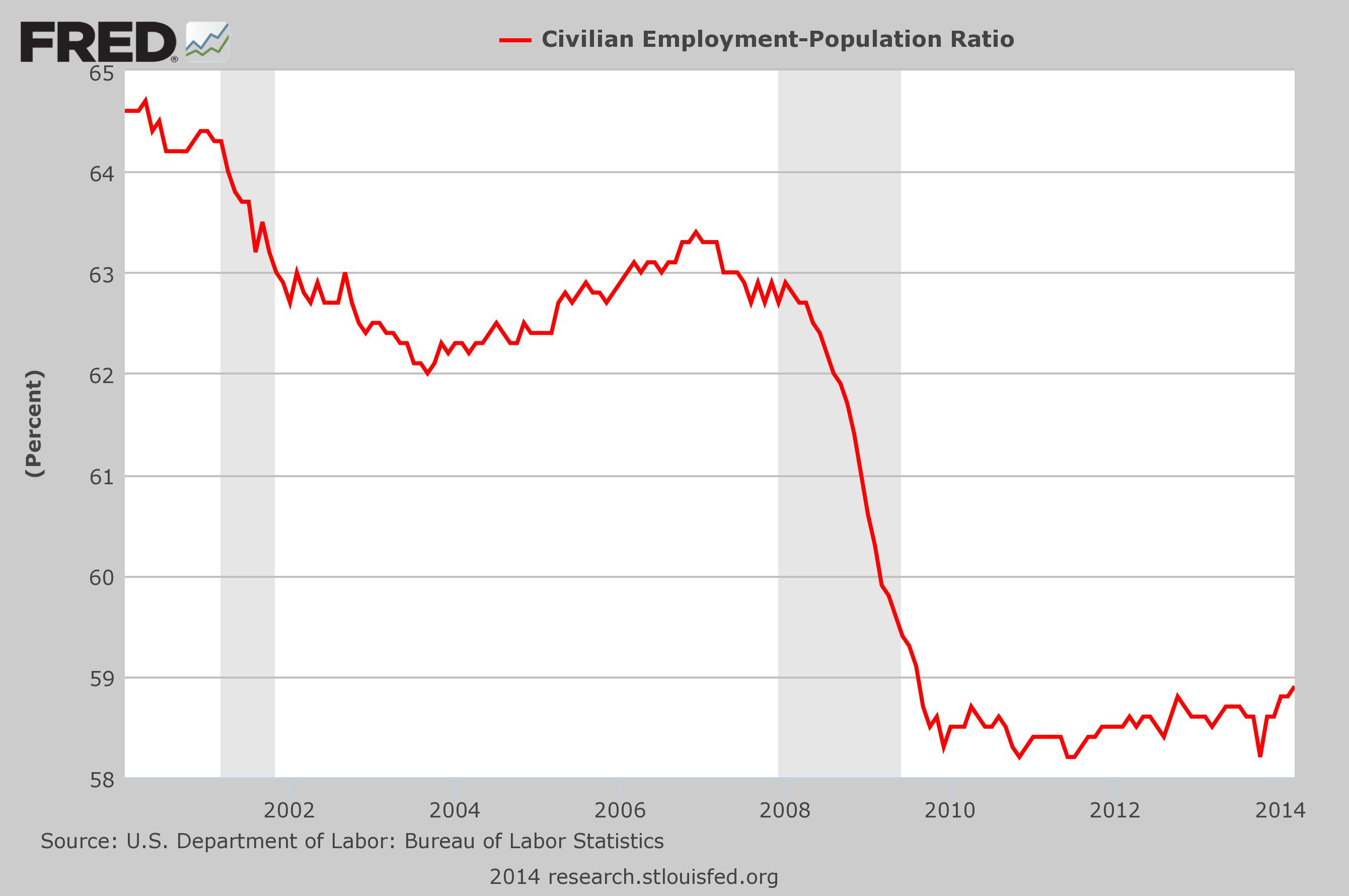
No, the economy is most definitely not "recovering".  Despite what you may hear from the politicians and from the mainstream media (shrugging off today's terrible GDP print), the truth is that the U.S. economy is in far worse shape than it was prior to the last recession.  In fact, we are still pretty much where we were at when the last recession finally ended.  When the financial crisis of 2008 struck, it took us down to a much lower level economically.  Thankfully, things have at least stabilized at this much lower level.  For example, the percentage of working age Americans that are employed has stayed remarkably flat for the past four years.  We should be grateful that things have not continued to get even worse.  It is almost as if someone has hit the "pause button" on the U.S. economy.  But things are definitely not getting better, and there are a whole host of signs that this bubble of false stability will soon come to an end and that our economic decline will accelerate once again.  The following are 17 facts to show to anyone that believes that the U.S. economy is just fine...
#1 The homeownership rate in the United States has dropped to the lowest level in 19 years.
#2 Consumer spending for durable goods has dropped by 3.23 percent since November.  This is a clear sign that an economic slowdown is ahead.
#3 Major retailers are closing stores at the fastest pace that we have seen since the collapse of Lehman Brothers.
#4 According to the Bureau of Labor Statistics, 20 percent of all families in the United States do not have a single member that is employed.  That means that one out of every five families in the entire country is completely unemployed.
#5 There are 1.3 million fewer jobs in the U.S. economy than when the last recession began in December 2007.  Meanwhile, our population has continued to grow steadily since that time.
#6 According to a new report from the National Employment Law Project, the quality of the jobs that have been "created" since the end of the last recession does not match the quality of the jobs lost during the last recession...
  • Lower-wage industries constituted 22 percent of recession losses, but 44 percent of recovery growth.
  • Mid-wage industries constituted 37 percent of recession losses, but only 26 percent of recovery growth.
  • Higher-wage industries constituted 41 percent of recession losses, and 30 percent of recovery growth.
#7 After adjusting for inflation, men who work full-time in America today make less money than men who worked full-time in America 40 years ago.
#8 It is hard to believe, but 62 percent of all Americans make $20 or less an hour at this point.
#9 Nine of the top ten occupations in the U.S. pay an average wage of less than $35,000 a year.
#10 The middle class in Canada now makes more money than the middle class in the United States does.
#11 According to one recent study, 40 percent of all Americans could not come up with $2000 right now even if there was a major emergency.
#12 Less than one out of every four Americans has enough money put away to cover six months of expenses if there was a job loss or major emergency.
#13 An astounding 56 percent of all Americans have subprime credit in 2014.
#14 As I wrote about the other day, there are now 49 million Americans that are dealing with food insecurity.
#15 Ten years ago, the number of women in the U.S. that had jobs outnumbered the number of women in the U.S. on food stamps by more than a 2 to 1 margin.  But now the number of women in the U.S. on food stamps actually exceeds the number of women that have jobs.
#16 69 percent of the federal budget is spent either on entitlements or on welfare programs.
#17 The number of Americans receiving benefits from the federal government each month exceeds the number of full-time workers in the private sector by more than 60 million.
Taken individually, those numbers are quite remarkable.
Taken collectively, they are absolutely breathtaking.
Yes, things have been improving for the wealthy for the last several years.  The stock market has soared to new record highs and real estate prices in the Hamptons have skyrocketed to unprecedented heights.
But that is not the real economy.  In the real economy, the middle class is being squeezed out of existence.  The quality of our jobs is declining and prices just keep rising.  This reality was reflected quite well in a comment that one of my readers left on one of my recent articles...
It is getting worse each passing month. The food bank I help out, has barely squeaked by the last 3 months. Donors are having to pull back, to take care of their own families. Wages down, prices up, simple math tells you we can not hold out much longer. Things are going up so fast, you have to adopt a new way of thinking. Example I just had to put new tires on my truck. Normally I would have tried to get by to next winter. But with the way prices are moving, I decide to get them while I could still afford them. It is the same way with food. I see nothing that will stop the upward trend for quite a while. So if you have a little money, and the space, buy it while you can afford it. And never forget, there will be some people worse off than you. Help them if you can.
And the false stock bubble that the wealthy are enjoying right now will not last that much longer.  It is an artificial bubble that has been pumped up by unprecedented money printing by the Federal Reserve, and like all bubbles that the Fed creates, it will eventually burst.
None of the long-term trends that are systematically destroying our economy have been addressed, and none of our major economic problems have been fixed.  In fact, as I showed in this recent article, we are actually in far worse shape than we were just prior to the last major financial crisis.
Let us hope that this current bubble of false stability lasts for as long as possible.
That is what I am hoping for.
But let us not be deceived into thinking that it is permanent.
It will soon burst, and then the real pain will begin.
Article by Michael Snyder of The Economic Collapse blog.

Wednesday, April 30, 2014

Russia Makes Friends: To Hold Military Drill With China; Strikes Multi-Billion Deals Bahrain And Iran. Eyeing Pipeline, Russia Forgives North Korean Debt

 The G-8 may be no more as the G-7 throws every possible case of harsh language known to man at the Kremlin, which obstinately refuses to back down, while re-escalating sanctions against a Russia which merely has done what the US does every single time its national interest abroad is threatened, but one thing is becoming ever clearer: while the west isolates Russia with ever stricter measures, Russia has decided to make some new friends.
Russia Makes Friends: To Hold Military Drill With China; Strikes Multi-Billion Deals Qatar And IranChina and Russia will hold a "maritime cooperation-2014" drill in East China Sea at end-May, Voice of Russia reports on its Chinese-language website yesterday.

China and Russia will conduct reconnaissance in the area within 3 days to prepare for the drill, the report says, citing an unidentified representative from Russian navy.

Earlier, the Russian military delegation of the Russian Navy, led by Viktor Karamazov Couchepi, arrived in Shanghai. Naval officials and representatives of the General Command of the Pacific Fleet met the Russian military delegation.
Such as Iran:
Russia Makes Friends: To Hold Military Drill With China; Strikes Multi-Billion Deals Qatar And IranIran and Russia are negotiating a power deal worth up to $10 billion in the face of increasing US financial alienation. The construction of new thermal and hydroelectric plants and a transmission network are in the works. Iran’s Energy Minister Hamid Chitchian met his Russian counterpart Aleksandr Novak in Tehran on Sunday in order to discuss the potential power deals, according to Iran’s Mehr news agency.

“[Expansion of] Iran-Russia relations are not only to the benefit of the two nations, but also are beneficial to entire region,” Iranian President, Hassan Rouhani, stated in a meeting with Novak in Tehran on Sunday, reported Iran’s FARS news agency.

Plans include the construction of hydroelectric and thermal generating plants and a new transmission network. The possibility of Russia exporting 500 megawatts of electricity to Iran is also on the cards, said Mehr.

The strengthening of economic ties between the two countries is of heightened significance given both economic sanctions on Iran, imposed with the aim of encouraging Iran to cut its uranium stockpiles, and new economic sanctions on Russian officials imposed on Monday.

On Sunday, Chitchian reportedly stressed “the need for further expansion of economic ties between Tehran and Moscow, particularly in the energy and commerce spheres,” stated Mehr.

Moscow has additionally been discussing the trade of 500,000 barrels a day of Iranian oil for Russian goods with Tehran. The protracted deal, first reported at the beginning of April could be worth as much as $20 billion, and has rattled Washington because it could bring Iran's crude exports above one million barrels a day - the threshold agreed upon in the nuclear deal between the P5+1 powers - US, Britain, France, China, Russia and Germany – and Iran.
such as Bahrain:
Russia Makes Friends: To Hold Military Drill With China; Strikes Multi-Billion Deals Qatar And IranThe governments of Bahrain and Russia have signed a deal to cooperate on investments, at a time when U.S. and European governments are imposing economic sanctions on Russia over the crisis in Ukraine.

Bahrain is a U.S. diplomatic ally in the Gulf, and its decision suggests Western sanctions may not deter other countries from continuing to expand business ties with Russia.

In a statement on Tuesday, the Russian Direct Investment Fund (RDIF) said it had signed a memorandum of understanding with Bahraini sovereign wealth fund Mumtalakat to identify and work together on investment opportunities in their countries. Mumtalakat chief executive Mahmood al-Kooheji will join the RDIF's international advisory board, helping to formulate its strategic direction, the statement added.

The Bahraini fund is one of the smaller sovereign funds in the Gulf, with $7.1 billion of assets as of last September. The RDIF is a $10 billion fund created by Russia's government to make equity investments, mainly in the Russian economy.
And Such as North Korea
 Eyeing Pipeline, Russia Forgives North Korean Debt
Reuters reported that Russia’s Duma voted to write off roughly $10 billion worth of the debt that North Korea owes Moscow from the days of the Soviet Union. The vote ratified an agreement made in September 2012, after a meeting between then-President Dmitry Medvedev and then-North Korean leader Kim Jong-il in Siberia in the summer of 2011.
At the time the agreement was first announced, The Guardian reported, citing Russia’s Finance Minister Sergei Storchak, that Moscow would forgive “90% of the debt and reinvest $1bn as part of a debt-for-aid plan to develop energy, health care and educational projects in North Korea.” Russian experts hailed the agreement as a sign that North Korea’s leadership was looking to initiate market style reforms in the reclusive country.
The Reuters report from this weekend said the deal ratified by the Duma on Friday would leave North Korea with about $1.09 billion worth of debt to Russia. North Korea would pay off that amount in six-month installations over the next twenty years. It also summarized Storchak as saying that the money Pyongyang pays back would be reinvested into North Korea.
North Korea was a strong ally of the Soviet Union during the Cold War, and Russia has forgiven the debt incurred by other Soviet allies like Cuba. However, the decision to forgive Pyongyang’s Soviet-era debt is most likely geared toward trying to bolster Russia’s plans to build a gas pipeline from its Sakhalin Island fields to South Korea via the North. The pipeline, which would also be accompanied by a railway, would reportedly carry 10 billion cubic meters of gas to South Korea annually. The gas would come from Russia’s state-owned energy company, Gazprom.
Moscow has been pushing for the Korean gas pipeline and railway for years as part of its strategy to diversify its energy markets away from Europe and toward Asia. This general goal has gained new urgency in the wake of Russia’s clash with the West over the Ukraine and Crimea.
The plan got a boost from Seoul over the weekend when South Korea’s Unification Ministry announced on Sunday that it had approved a trip to Pyongyang by Choi Yeon-hye, the president and CEO of the Korea Railroad Corp. Choi will lead a South Korean delegation to the Organization for Co-Operation between Railways (OSJD) meeting in the North Korean capital scheduled for April 24-28. Chinese and Russian rail officials will also be at the meeting, according to South Korean media outlets.

 If nothing else, at least it shows just how seriously the rest of the world (away from those G-7 members who are as insolvent as the US of course) is taking US sanctions and threats of retaliation. Meanwhile, back in the US, rigged stocks hit intraday highs on what we would otherwise call BTFWWWIIID... if only there was a D.