Tuesday, August 12, 2014

Rally in zinc set to stall

Rally in zinc set to stall
Chinese smelters increase production to take advantage of bull run

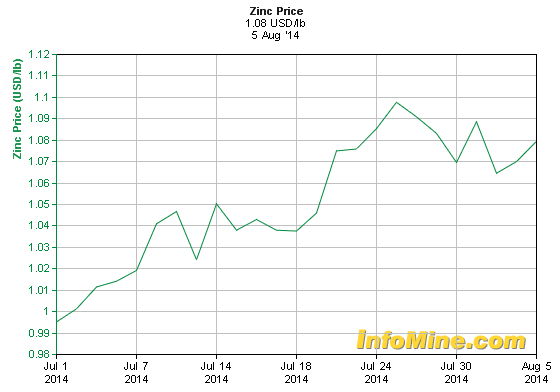
With a gain of over 20 per cent in the last 12 months, zinc is one of the top five gainers among ferrous and non-ferrous metals in the commodities market. But it is unlikely that zinc will make much headway over the next few months.
One of the reasons for the rally to stall will be rising supply especially with China increasing the output to benefit from the high prices that are prevailing now. A sign of things to come could possible be last week’s fall in zinc prices by four per cent.
Price forecast
On Monday, zinc fell below $2,300 a tonne to $2,295 for delivery in November. From the weekend closing, the drop was $34.
BNP Paribas sees zinc averaging $2,205 in the October quarter and $2,270 in the last quarter. Currently, cash zinc prices are ruling at $2,332 and they are expected to drop to levels of $2,090 this year, according to analysts. Next year, prices could rise to $2,244.
Last week, price fell mainly because London Metal Exchange inventories increased by over five per cent to 6.91 lakh tonnes. It was biggest rise in a week after April. Inventories have also increased in China.
Speculation
Ironically, zinc zoomed because stocks are down by 2.41 lakh tonnes a year. So, what has changed now that the zinc’s progress could be halted?
According to Hermes Fund Managers Ltd, stocks in Chinese warehouses are rising. Reuters quoted Joseph Murphy, analyst with Herms Fund, as saying that the metals market is seeing drawdown in LME stocks but at the same time warehouse stocks are on the rise.
Zinc smelters will get better returns for producing more, which could result in the metal prices being dented.
Hermes said refined zinc demand will exceed supply by 2.5 lakh tonnes this year and 2 lakh tonnes next year, according to BNP.
Traders on LME say that speculation in zinc is ending by shifting to other metals such as aluminium, nickel and lead.
Funds have cut their bearish bets to 39,368, according to LME commitment of traders data, down from over 40,000 in the last week on July.
Copper fallout
Murphy said that ample supplies of zinc concentrate and higher charges for treating apart from surging domestic prices should encourage smelters in China to boost zinc output.
Zinc is also gaining because a probe by Chinese officials revealed that copper is being used as a financial tool. This has moved speculators and hedge funds to zinc on the Shanghai Futures Exchange.
The increasing interest in zinc is supported by Chinese data showing rise in imports to 68,476 tonnes in June, a six-month high. In comparison, copper imports have been dropping since April.
The problem with copper and aluminium is that Chinese authorities suspect that stocks of these metals have been offered as collateral manifold by a multi-national firm owned by a Singaporean.
But now with stocks tending to rise, some traders have taken their foot off the accelerator, while others have begun to cash in their position.
Some commodity brokerages have told their clients to hold back investments of zinc since it had run up too fast.
A drop in prices of zinc, used mainly for steel galvanising, means India could tend to gain as domestic rates are based on 15-day LME average.
hindubusinessline

Lead up on supply concerns

Lead up on supply concerns
Increase in demand and widening deficit to support price rise
Lead prices on the LME have risen 9.5 per cent since March, led by a slowdown in mine production and a relatively higher demand. Lead is used largely in car batteries. About 80 per cent of the metal is used in the lead acid batteries used in vehicles.
According to data from Bloomberg, the number of lead-acid batteries in newly assembled passenger and light vehicles is projected to go up 4.8 per cent in 2014 to 86.82 million. The pick-up in the global automobile sector is a big plus for the lead market.
In the domestic market too, lead futures on MCX have been moving up. Traders who have a medium-term outlook can go long on the contract.
Demand outstrips supply

Demand for refined lead, which was up just 0.4 per cent in 2012, surged 7 per cent in 2013 to 11.22 million tonnes. This year, the International Lead and Zinc Study Group (ILZSG) forecasts demand to increase over 4 per cent to 11.73 million tonnes.
China, the world’s largest consumer of lead, is expected to show a large appetite for the metal. Though the country’s lead consumption in the first four months of this year (January-April) is down 10 per cent, ILZSG forecasts it to rise 7.4 per cent for the full year.
Supply, however, is going to be tight. The global output of lead from mines is expected to rise by just 5 per cent in 2014 after a 7.6 per cent increase in 2013, says the ILZSG, widening the deficit in the market.
From a 1,000-tonne shortage in 2013, deficit in lead in the first four months of this year has widened to 12,000 tonnes. The ILZSG estimates the shortage to widen to 50,000 tonnes in 2014. Increasing deficit will help lead prices crawl up.
India relies largely on imports to meet its domestic lead demand. Data from the Ministry of Commerce show that after two consecutive years of a fall in imports from 2010-11, lead imports surged 25 per cent in 2012-13 and 2 per cent in 2013-14.
A weak rupee could keep domestic lead prices higher this year with the metal’s futures price broadly tracking international prices.
Technical outlook

Medium-term view: The medium-term outlook for the MCX-lead (₹137 per kg) futures contract is bullish. The strong downtrend that was in place since August 2013 reversed last month.
Also, as this reversal has happened after forming a double bottom pattern between March and June this year, the chart looks very bullish now. The neckline support of this pattern is at ₹130.
The bullish outlook will remain intact as long as the contract trades above this level. Intermediate dips to this support level may attract fresh buying interest.
So traders with a medium-term perspective can go long on the contract at current levels. More long positions can be accumulated at ₹135 and ₹132 if an intermediate pullback is seen. Stop-loss can be kept at ₹127 for a target of ₹150.
The medium-term outlook will turn bearish only if the contract falls decisively below ₹120. The ensuing target on such a break will be ₹115.
Short-term view: MCX lead is in a strong uptrend in the short-term perspective as well.
The contract has consolidated in the form of a triangle in the last week of July and has witnessed a bullish breakout last week.
Immediate support for the contract is at ₹136. The 21-day moving average at ₹134 is a key short-term support for the contract. Above this level, a rally to ₹145 looks likely in the short term.
The outlook will turn negative only if the contract records a strong close below the 21-day moving average level.
The targets on such a break will be ₹130.

hindubusinessline

Looking For The Spark Of World War 3 ?

Looking For The Spark Of World War 3 ?

Any American influence left in Iraq should focus on rebuilding the credibility of national institutions.

– Editorial, The New York Times
Gosh, isn’t that what we spent eight years, 4,500 lives, and $1.7 trillion doing? And how did that work out?The Iraq war is just like the US financial system. The people in charge can’t imagine writing off their losses. Which, from the policy standpoint, leaves the USA pounding sand down so many rat holes that there may be no ground left to stand on anywhere. We’ll be lucky if our national life doesn’t soon resemble The Revenge of the Mole People.
The arc of this story points to at least one likely conclusion: the dreadful day that ISIS (shorthand for whatever they call themselves) overruns the US Green Zone in Baghdad. Won’t that be a nauseating spectacle? Perhaps just in time for the 2014 US elections. And what do you suppose the policy meeting will be like in the White House war room the day after?
Will anyone argue that the USA just take a break from further operations in the entire Middle East / North Africa region? My recommendation would be to stand back, do nothing, and see what happens — since everything we’ve done so far just leaves things and lives shattered. Let’s even say that ISIS ends up consolidating power in Iraq, Syria, and some other places. The whole region will get a very colorful demonstration of what it is like to live under an 11th century style psychopathic despotism, and then the people left after the orgy of beheading and crucifixion can decide if they like it. The experience might be clarifying.
In any case, what we’re witnessing in the Middle East — apparently unbeknownst to the newspapers and the cable news orgs — is what happens in extreme population overshoot: chaos, murder, economic collapse. The human population in this desolate corner of the world has expanded on the artificial nutriment of oil profits, which have allowed governments to keep feeding their people, and maintaining an artificial middle class to work in meaningless bureaucratic offices where, at best, they do nothing and, at worst, hassle their fellow citizens for bribes and payoffs.
There is not a nation on earth that is preparing intelligently for the end of oil — and by that I mean 1) the end of cheap, affordable oil, and 2) the permanent destabilization of existing oil supply lines. Both of these conditions should be visible now in the evolving geopolitical dynamic, but nobody is paying attention, for instance, in the hubbub over Ukraine. That feckless, unfortunate, and tragic would-be nation, prompted by EU and US puppeteers, just replied to the latest trade sanction salvo from Russia by declaring it would block the delivery of Russian gas to Europe through pipelines on its territory. I hope everybody west of Dnepropetrovsk is getting ready to burn the furniture come November. But that just shows how completely irrational the situation has become… and I stray from my point.
Which is that in the worst case that ISIS succeeds in establishing a sprawling caliphate, they will never be able to govern it successfully, only preside over an awesome episode of bloodletting and social collapse. This is especially true in what is now called Saudi Arabia, with its sclerotic ruling elite clinging to power. If and when the ISIS maniacs come rolling in on a cavalcade of You-Tube beheading videos, what are the chances that the technicians running the oil infrastructure there will stick around on the job? And could ISIS run all that machinery themselves? I wouldn’t count on it. And I wouldn’t count on global oil supply lines continuing to function in the way the world requires them to. If you’re looking for the near-future spark of World War Three, start there.
By the way, the US is no less idiotic than Ukraine. We’ve sold ourselves the story that shale oil will insulate us from all the woes and conflicts breaking out elsewhere in the world over the dissolving oil economy paradigm. The shale oil story is false. By my reckoning we have about a year left of the drive-to-Walmart-economy before the public broadly gets what trouble we’re in. The amazing thing is that the public might get to that realization even before its political leadership does. That dynamic leads straight to the previously unthinkable (not for 150 years, anyway) breakup of the United States.

Monday, August 11, 2014

What A Wonderful Thing To Understand. Metal-Forex-Trader 700th Post, Thanks To Everyone, Keep on Reading.

What A Wonderful Thing To Understand. Metal-Forex-Trader 700th Post, Thanks To Everyone, Keep on Reading.

This is what implied to our trade too, holding a position which is in loss, give us the same stress and worries, if we are not following stop losses. It's an individual capacity how long he can hold.
Remember to put the glass down as soon as possible.

The CDC's Worst Nightmare (Or What Nigeria Has To Look Forward To)

With more than 1600 people in Guinea, Liberia, and Sierra Leone having contracted Ebola since March, CDC Director Frieden's "deeply concerned about Lagos, Nigeria" worst nightmare looks set to come true as the pace of cases (and deaths) in the nation begins to accelerate. As the following chart shows, Nigeria - now in a state of national emergency - has this to look forward to (though on a scale significantly higher since population density is dramatically higher).
This is already the worst outbreak in history...
The CDC's Worst Nightmare (Or What Nigeria Has To Look Forward To)
And it's getting worse...
The CDC's Worst Nightmare (Or What Nigeria Has To Look Forward To)

Hedge Funds Snub Natural Gas Rally as Supply Gains Loom

Hedge Funds Snub Natural Gas Rally as Supply Gains Loom
Hedge funds are betting that the rally in U.S. natural-gas prices won’t last.
Money managers cut the combined net-long position across four benchmark contracts by 21 percent in the week ended Aug. 5, after 15 weeks of above-average stockpile increases. Bullish wagers retreated to an 18-month low even as futures traded in New York gained 2.3 percent in the report week, U.S. Commodity Futures Trading Commission data show.
Goldman Sachs Group Inc. cut its price forecast last week as shale-gas production in the eastern U.S. surged to an all-time high. Power demand in June and July fell to five-year seasonal lows amid unusually cool weather from Texas to Boston, Edison Electric Institute data show. Gas futures have dropped 12 percent since the start of summer.
“If you are a money manager and you see above-average storage injections week after week and a decline in price, selling is rational,” Tim Evans, an energy analyst at Citi Futures in New York, said by phone Aug. 8. “There’s no massive heat wave consistently across the U.S. that is going to spike air-conditioning demand, and we continue to see production numbers that show robust growth.”
Natural gas advanced 8.9 cents to $3.897 per million British thermal units on the New York Mercantile Exchange in the period covered by the CFTC report. The contract for September delivery closed at $3.962 on Aug. 8.

Stockpile Gains

Gas inventories rose by 1.567 trillion cubic feet since late March to 2.389 trillion on Aug. 1, the fastest pace of storage injections for the period in U.S. Energy Information Administration data going back to 1994. A deficit to the five-year average narrowed to 20 percent from a record 55 percent.
Power generation in the lower 48 states averaged 83,230 gigawatt-hours from June through July, the least for these months since 2009, Edison Electric data show.
“Extreme heat that would normally cause a lot of A/C demand has not materialized at all,” Kyle Cooper, director of research with IAF Advisors and Cypress Energy Capital Management in Houston, said by phone Aug. 7.

Goldman Sachs

Goldman Sachs reduced its outlook for the fourth quarter to $4 from $4.25, Brian Singer, a New York-based analyst with the bank, wrote in an Aug. 8 note.
Below-normal temperatures in eastern states through Aug. 17 will be followed by above-average readings along the East Coast, said MDA Weather Services in Gaithersburg, Maryland.
The EIA says record production will help boost U.S. supplies to 3.431 trillion cubic feet by the end of October as new wells come online at shale deposits such as the Marcellus in the Northeast, where daily output topped 15 billion cubic feet for the first time last month.
In other markets, net-long positions in benchmark West Texas Intermediate crude fell by 40,360 contracts, or 15 percent, to 236,381 futures and options. Longs fell 7.3 percent, while shorts surged 56 percent. WTI dropped 3.6 percent to $97.38 a barrel in the report week.
WTI futures climbed as much as $1.11 on Aug. 8 as U.S. warplanes attacked Islamic State militants in Iraq, before settling 31 cents higher at $97.65. Prices were down 6 cents to $97.59 at 6:51 p.m. yesterday in New York.

U.S. Airstrikes

Coming to the aid of Kurdish forces near Erbil, the regional capital, the U.S. used fighter jets and armed drones yesterday to destroy several armed trucks and a mortar position held by militants, the U.S. Central Command in Tampa, Florida, said in a statement. Iraq’s parliament adjourned for a week without breaking a deadlock over who should become the next prime minister.
Prices reached a nine-month high in June after the militants captured the Iraqi city of Mosul, before dropping when the rebel advance stalled, sparing the country’s south, home to more than three-quarters of its oil output.
“There’s been an upsurge in geopolitical tension but no interruption of supply so investors see no reason to jump into the market,” John Kilduff, a partner at Again Capital LLC, a New York-based hedge fund that focuses on energy, said in an Aug. 8 interview.
Bullish bets on gasoline dropped 1,591 contracts, or 5.2 percent, to 29,164, the lowest since February. Gasoline futures dropped 5.4 percent to $2.7155 a gallon on the New York Mercantile Exchange in the period covered by the CFTC report, the lowest settlement since Feb. 6.

Pump Prices

Regular gasoline at the pump, averaged nationwide, rose to $3.478 a gallon Aug. 9, according to Heathrow, Florida-based AAA, the largest U.S. motoring group. Prices had slipped to $3.475 Aug. 6, the lowest level since March.
Net-short positions in ultra low sulfur diesel more than doubled to 18,602 contracts, the most since June 2013. The fuel dropped 2.1 percent to $2.8469 a gallon in the report week.
Net-long positions on four U.S. natural gas contracts declined by 40,542 futures equivalents to 152,007, the lowest level since Nov. 26. Bullish wagers have dropped in 14 of the past 15 weeks.
The measure includes an index of four contracts adjusted to futures equivalents: Nymex natural gas futures, Nymex Henry Hub Swap Futures, Nymex ClearPort Henry Hub Penultimate Swaps and the ICE Futures U.S. Henry Hub contract. Henry Hub, in Erath, Louisiana, is the delivery point for Nymex futures, a benchmark price for the fuel.
Long positions fell 7.5 percent to 433,643, the least since Jan. 15, 2013.
“Money managers have been cutting their exposure to natural gas since February and this is just following through on that decision,” Evans said. “Prices are still below $4 and it’s not clear that the recovery we saw this week is going to be sustained.”
To contact the reporter on this story: Naureen S. Malik in New York at nmalik28@bloomberg.net

Sunday, August 10, 2014

Visualizing The Costs Of Drug Addiction

Drug addiction ravages the health of the body and mind, but it can also be ruinous to the wallet.Here is a look at the financial costs associated with drug addiction and treatment, which for most people includes counseling.

Economics of Addiction

Only 3.46 Crore TAX PAYERS In India.Total Population Over 125 Crore.

Only 3.46 Crore TAX PAYERS In India.Total Population Over 125 Crore.

Novelis hikes aluminum sheet product prices in North America

Novelis hikes aluminum sheet product prices in North America
Novelis has announced price hikes for automotive and specialty aluminum sheet products in North America. The revised prices will be applicable for all new orders effective immediately, Novelis added. However, all existing orders and firm agreements prior to August 7th will conform to old price.
Among automotive products, the 6000-series automotive alloys will see an increase on $0.06 per pound. The 5000-series automotive alloys prices will witness a similar jump of $0.06 per pound. Among specialty products, the prices of 1000-series and 3000-series of alloys will be hiked by $0.05 per pound. An increase of $0.03 per pound will be applied to 5000-series products. Also, 6061-O prices will be increased by $0.03 per pound. The price increase in automotive products is in addition to the pricing adjustments announced earlier in January this year.
The company also announced its commitment to the promised capacity additions and expansion in North American region. It has already commissioned two new auto finishing lines in Oswego, New York. The completion of the third line is expected soon. This is expected to lift the company’s capacity in the region to 360,000 tons per year. It also announced that the commissioning of the finishing lines in Changzhou, China and Nachterstedt, Germany would take the global capacity to 900,000 tons per year by end-2015.
Headquartered in Atlanta, Georgia, Novelis Inc. is the leading producer of rolled aluminum products. They are also the world’s largest recycler of aluminum.

Friday, August 8, 2014

Crude oil rises as Obama authorises air strikes in Iraq

Oil prices rose in Asia today after US President Barack Obama said that he has authorized air strikes against Sunni extremist militants in key crude producer Iraq.
US benchmark West Texas Intermediate crude for September delivery rose 35 cents to $97.69, while Brent crude for September delivery gained 67 cents to $106.11 in mid-morning trade.
Crude oil rises as Obama authorises air strikes in Iraq
Obama in an address yesterday said that he had ordered the air strikes to prevent “genocide” by the so-called Islamic State fighters against the besieged Yazidi minority in Iraq’s north.
“I therefore authorized targeted air strikes if necessary to help forces in Iraq as they fight to break the siege and protect the civilians trapped there,” Obama said.
He did not say whether air strikes have already been carried out.
Desmond Chua, market analyst at CMC Markets in Singapore, said the development could add “significant risk premium to oil prices” as dealers worry about potential supply disruptions.
“The announcement certainly edges up the geopolitical concerns about Iraq and the Middle East region, and comes as a bit of a surprise to investors,” Chua told AFP.
Islamic State insurgents now control large swathes of Iraq’s north and west. The sweeping offensive began on June 9, preventing Baghdad from exporting oil via a pipeline to Turkey and by road to Jordan.
Iraq’s oil ministry had on July 24 said crude exports totalled 2.42 million barrels per day in June, falling far short of a budgeted projection of 3.4 million bpd.
As the number-two producer in the OPEC cartel, Iraq’s 11 per cent of proven world reserves plays a key role in world markets and prices after violence disrupted oil exports from Syria and Libya.
The dip in exports adds to the woes of Iraq, which is heavily dependent on oil revenues, while spending more on military equipment to battle the Islamic State group.

Copper price tumbles on dismal China data, Indonesia exports

Copper price tumbles on dismal China data, Indonesia exports
In pre-open New York trade on Wednesday September copper slid more than 1% to a low of $3.1660 a pound after data out of China showed unexpected weakness and new supply come onto the market.
Growth in China’s services sector slowed sharply in July to its lowest level in nearly nine years according toan HSBC survey of purchasing managers.
Tightness in China's domestic supply is easing, evidenced by a tumble in Shanghai premiums
Hongbin Qu, Chief Economist, China & Co-Head of Asian Economic Research at HSBC commented the weakness likely reflects the impact of the ongoing property slowdown in many cities and that the date "points to the need of continued policy support to offset the drag from the property correction."

The numbers are in stark contrast to the improved activity registered by the country's manufacturing sector.
The price of the red metal was also hurt by the prospect of at least 756,000 tonnes of concentrate (holding roughly 225,000 tonnes of metal) coming onto the market as Freeport McMoRan (NYSE:FCX) restarts exporting copper concentrate from Indonesia after a six-month hiatus.
Copper has been in recovery mode since hitting a near four-year low mid-March of $2.92 a pound as global stockpiles continued to decline.
Currently, copper inventories at warehouse operated by the London Metals Exchange, Shanghai Metals Exchange and on the Comex market in New York stand at roughly 275,000 tonnes, down almost by half year to date.
Growing scrutiny of China's copper financing trade may keep copper prices under pressure
But tightness in China's domestic supply are easing evidenced by a fall in premiums for copper in Shanghai warehouses to $85 a tonne, down from $105 a month ago.

China which consumes more than 40% of the world's copper imports tumbled 8% in June to 350,000 tonnes compared to the previous month.
The fall is blamed on Beijing's crackdown on the practice of using warehoused inventories as collateral for trade finance after fraudulent transactions were uncovered at the major port of Qingdao.
Reuters quotes a Commonwealth Bank of Australia research note saying the slump in imports may indicate "the growing scrutiny of China's copper financing trade may weaken China's apparent copper demand and keep copper prices under pressure."
However, year to date China is still importing refined copper at a record setting pace – up a whopping 26% over 2013 to 2.52 million tonnes.
The copper price is highly correlated with economic growth thanks to the widespread use of the metal in the construction, transport and power industries, and the robustness of the red metal is prompting industry to switch to much cheaper aluminum for some applications.

Zinc becoming investors new darling

Instability in precious and base metals prices during the past three months has pushed investors to find alternative objects of affection, with zinc quickly becoming a favourite and hitting near three-year highs, a report published Tuesday by the London Metal Exchange shows.
Prices for the metal, mainly used as a protective coating for iron and steel in construction, have jumped almost 17% since early May, hitting $2,410 a tonne late July amid worries over mine supply and falling warehouse stocks.
Experts remain bullish on the metal outlook despite a temporary pullback in prices in the last two days. Zinc fell Wednesday for a second day in London amid expanding stockpiles and speculation that a strengthening dollar will slow demand for the metal.
Zinc becoming investors new darling
But bets on rising zinc prices, or long positions, accounted for 30% of total open interest as of Aug. 1, the most among the six metals traded by LME, according to its Commitments of Traders report. Money managers are net-long all of the metals, the data showed.
And according to analysts, such as Naveen Joshi, the level of underlying demand for zinc, coupled with the fact that new mine supply would not be added anytime soon could lead to the emergence of tightness in supply side over the next two years.
“Zinc has now become one of the hottest commodities in the world. The global imbalances with regards to higher demands and supply constraints would make the prices of the metal go higher not only in the short term but also long term,” he writes.
LME zinc stocks have increased 1.5%, the most since April 1, to 668,625 tons on a jump in New Orleans.

Gold Jumps As Ukrainian Fighter-Jet Shot Down Over Donetsk

Gold futures broke above $1315 as a double whammy of NATO threats and Ukraine headlines spark safe-haven buying:
  • *FIGHTER JET SHOT DOWN OVER REBEL-HELD EAST UKRAINE: AFP
10Y Treasury yields are under 2.43% and JPY is strengthening once again as carry trades are unwound.

As Bloomberg notes, Fighter jet shot down over East Ukraine, AFP reports, without citing where it obtained the information.
As AFP reports,
Ukranian fighter jet was shot down on Thursday as it flew low over rebel-held territory in the east of the country, an AFP journalist witnessed.

The aircraft crashed into a field after an explosion and the pilot was seen parachuting out in an area some 40km east of the insurgent bastion of Donetsk
The reaction...
Gold Jumps As Ukrainian Fighter-Jet Shot Down Over Donetsk

Thursday, August 7, 2014

Gold Jumps $20, Most In 2 Months On NATO Headlines

Talking-heads drew "this is not geopolitical risk fears" comfort yesterday that the stock sell-off was not accompanied by a big bid for gold.
 Today... not so much. Gold and silver have surged since around 8amET (when Ukraine incursion headlines began today from NATO) with the yellow metal up over $20 - its biggest jump since mid-Jun (with futures over $1310).

Gold Jumps $20, Most In 2 Months On NATO Headlines

Russian Defense Minister Tells Troops "To Be In State Of Constant Battle Readiness"

Having discussed his view that the Ukraine government is at fault for worsening the conflict, Russia's Putin explained to Angela Merkel that a "rising civilian toll has created a humanitarian crisis in Ukraine." However, it was Defense Minister Sergei Shoigu's comments that "the world has changed and changed dramatically," demanding that his troops "must be in constant combat readiness," are the most disconcerting as his strong tone in the following clip appears to confirm Poland and NATO's fears.

Putin's conversation with Merkel...
Russian President Vladimir Putin, German Chancellor Angela Merkel spoke by phone, exchanged views on “intensifying crisis situation” in Ukraine, Kremlin says in e-mailed statement.

*PUTIN TELLS MERKEL UKRAINE GOVT AT FAULT FOR WORSENING CONFLICT

Putin says “real political dialogue” needed between authorities in Kiev and representatives of rebels

Offensive by Ukrainian forces in southeast leads to mounting civilian toll, humanitarian problems: Putin
Shoigu starts talking (in Russian) at around 30 second mark, clip includes coverage of the military drills that are under way...

Sergey Shoigu, Russia's Defense Minister said that "Peacekeeping units should be in a state of constant battle readiness."

He added: "The world has changed, and has changed dramatically. As you know from previous examples, including in the brigade, peacekeeping units can be activated without warning."

After checking the 15th motorized rifle brigade of peacekeeping forces, the defense minister said that now all peacekeeping brigades are staffed exclusively by contractors, reported "Interfax".

Meanwhile, the humanitarian crisis in eastern Ukraine is getting worse by the day. Today the problems of those who are located in the eastern Ukraine zone where the Ukrainian army has been dispatched was discussed at an emergency meeting of the UN Security Council.

According to recent reports, the casualties of the conflict now amount to 1,400 people, with more than four thousand injured. In addition, about 300,000 people have fled their homes.
"Prepare for the unexpected," Shoigu concludes...

Is August a better month for Commodities?

 Is August a better month for Commodities?
Commodities collectively had their worst monthly performance in more than two years during July and the group could push somewhat lower in August. 
According to INTL FCStone, August as usually a messy month for equities leading to an even sloppier September. 

“If we are correct on our view on U.S. equities, we could see spillover selling hitting precious metals, oil, and some of the base metals, at least initially, before the various asset classes start to decouple,” said INTL FCStone in its monthly outlook. 

INTL FCStone's Precious Metals and Energy Outlook for August
Gold is already struggling under the prospect of decent growth in both China and the US lackluster investment demand, poor technicals and the likelihood of higher U.S. rates going into 2015.

Platinum and palladium could also ease a bit this month, although their fundamentals look much better than gold. Oil markets are oversupplied and with various geopolitical hotspots not imperiling oil flows, at least for the moment, we think the path of least resistance is lower still. 

INTL FCStone believes that lower trading ranges are also in store for energy products, as well as for natural gas. 

INTL FCStone's Base Metals Outlook for August
Base metals have regained some lost ground this week, but INTL FCStone thinks that some in the group are overextended based on fundamentals. 
Zinc, in particular, is now at a three-year high and INTL FCStone believes prices have more than discounted the complex’s improving supply/demand profile, while not adequately discounting the very real possibility of a further contraction in the Chinese real estate market.

However, INTL FCStone said lead has not participated fully in the recent base metals advance and we still like its story heading into the second half of the year. 

The firm describes itself as neutral on copper at current prices, looking for a sideways range this month.

Peru calls off ban on Tia Maria

Peru calls off ban on Tia Maria
Tia Maria copper mine has been stalled since 2011 due to the protest from the residents claiming that the working of mine may contaminate the drinking water facility of the neighborhood.
As the mine being one of the biggest mining projects issued in Peru, the ministry has not decided letting go off the project easily. Mines and Energy ministry of Peru announced on Monday that the environmental impact study based on the project has been approved by the government.
Many Projects in Peru has been put on hold due to the violent protests held by the residents and environmental activists. Even though Peru is a large reserve of minerals like gold, silver, zinc and copper, due to these protests and hardships from the residents, nothing is fully utilized.
One of the world’s biggest producer of copper, Southern Copper have stated that, the project Tia Maria will annually produce at least 120,000 tons of copper and will last for at least a period of twenty years. Oscar Gonzalez Rocha, the chief executive of Southern Copper said that they are hoping to start the production at Tia Maria by 2017; mostly at the beginning of the year. He also added that, the company is still to receive the license for the project. The project is to be launched at the Southern part of Peru; precisely at Arequipa region. The construction of the plant was stopped due to the protests held regarding the pollution caused by the plant.
According to the government of Peru, the country will most probably produce 2.8 million tons of copper by the year 2016, which is almost double the production of present year, as the government is expecting number of new projects to start their production.

Nickel Stockpiles at Record High as China Turns Exporter

Nickel Stockpiles at Record High as China Turns Exporter
Image Source http://www.economic-design.com/
Nickel inventories in warehouses monitored by the London Metal Exchange extended gains to a record after China, the biggest producer and consumer, shipped more metal out than it imported amid a financing scandal.
Stockpiles climbed to 317,874 metric tons, for a 21 percent increase this year, according to the LME data. Exports of refined nickel from China almost tripled in June to 16,737 tons, exceeding imports for the first time ever by 5,723 tons, customs data show. Nickel is used to make stainless steel.
“The recent build is probably attributable to the pick-up in refined nickel exports that came out of China,” Nicholas Snowdon, an analyst at Standard Chartered Plc in London, said by phone. “That is most likely related to some constraints on financing.”
Nickel has gained the most of the six main metals on the LME this year, rising as much as 56 percent after the largest miner Indonesia banned exports of unprocessed ore, a raw material used to make a lower-grade nickel substitute known as nickel-pig iron. Refined nickel production will exceed demand by 44,200 tons this year before turning into shortage of 97,100 tons in 2015, according to Morgan Stanley.
Prices have pared gains to 35 percent this year, to $18,730 a ton, on speculation that supplies are sufficient for now as stockpiles climbed to a record. The probe into metal inventories held at China’s Qingdao port in June led banks to cut back on financing, leading to more exports.

Less Financing

“It’s entirely possible that metal that was being financed, is now not,” said David Wilson, an analyst at Citigroup Inc. in London. “Financing has been more difficult everywhere because of less liquidity being provided.”
Stockpiles of full-plate cathodes increased 36 percent since the start of June in Johor, and almost doubled in Singapore over the same period, according to the LME data. There are two Chinese companies approved to deliver their nickel cathode into LME warehouses.
Refined nickel approved by the LME is used in about one-third of nickel demand as consumers first use scrap, ferronickel, nickel-pig iron or off-grade material, according to Citigroup. The LME’s network of more than 700 depots worldwide doesn’t stretch to China, the biggest consumer of industrial metals.
Warehouses in Johor, Malaysia, have 157,200 tons of refined nickel, or 49 percent of the LME total and are 38 percent higher for this year. The total LME nickel stockpiles equal about 1.5 months of consumption, Anton Berlin, head of strategic marketing at OAO GMK Norilsk Nickel, said in an interview.

Nickel Briquettes

More than 80 percent of refined nickel stored in Johor is in the form of briquettes, which have been delivered throughout this year. The material probably came from Australia, according to Citigroup.
BHP Billiton Ltd. and Minara Resources Ltd., owned by Glencore Plc, are Australian producers whose brands are approved by the LME, according to the bourse’s website. The metal may not be available for immediate release, Wilson said.
“You’ve had this big build-up of briquettes in Johor,” Wilson said. “I suspect we’ll continue to see those briquettes being built. Whether they’re actually available is a very different question. They’re not necessarily available to everybody unless they want to pay a decent premium for them.”
Nickel inventories should start to fall by the middle of next year as stainless-steel producers in China are forced to switch from using nickel-pig iron to other forms of nickel and ultimately the refined metal, according to Standard Chartered. High stockpiles will probably cap prices until a shortage takes hold, National Australia Bank Ltd. said in a report Aug. 4.

China's MCC shuts Ramu nickel mine in PNG after attacks

China's MCC shuts Ramu nickel mine in PNG after attacks
The Ramu nickel and cobalt mine in Papua New Guinea was shut this week by its Chinese owners after it was attacked by villagers on Monday, according to media reports.
The mine, forecast to produce 22,000 tonnes of nickel in 2014, is operated by Ramu NiCo, which is majority owned and run by Metallurgical Corporation of China Ltd 
Ramu NiCo said equipment, including computers, printers, and phones, "costing millions of kina" were badly damaged or removed from its office, according to The Australian newspaper.
One local report said preliminary investigations found the attacks were spurred by concerns about the company's hiring policies for mine workers, while Ramu NiCo has been focusing on training locals to be able to work at the mine.
Minority owner Highlands Pacific's top executives and a spokesman were not immediately available to comment on the situation at the mine.

Wednesday, August 6, 2014

Bigger Losses May Happen in Base Metal Market if Price Breaks Key Support Levels

Bigger Losses May Happen in Base Metal Market if Price Breaks Key Support Levels
The geopolitical risks are escalating now, sending the US dollar index up to a 10-month high. Concerns over global credit risks also combine to shadow the market. As a result, the global commodity market fell across the board. Base metal prices, however, succeeded to find support at key levels.
“If prices fall below those key support levels ( copper 7,030-7050; aluminum 1,980-1990; zinc 2,340-2350; lead 2,230-2240), cash will fly away from the market, and this will trigger bigger losses”, one analyst said. He added that prices will fall back from initial highs as the second half of 2014 goes on.