Wednesday, September 10, 2014

Nickel price rally still has a long way to go

Nickel price rally still has a long way to go
Indonesia, supplying more than a fifth of global exports, surprised the mining world in January by putting into effect an outright ban on nickel ore exports.
Initially record warehouse inventories, massive stockpiling by Chinese pig iron producers and growing mine supply kept a lid on the price which was languishing at near five-year lows below $14,000 a tonne at the start of the year.
But the Asian nation, against expectations, stuck to its guns and the ban, in combination with fears that tensions with Russia could affect supply from top miner Norilsk, sent the price of the steelmaking ingredient above $20,000 in May.
The price subsequently pulled back from those levels, but last week saw nickel take another stab at $20,000 a tonne after the Philippines – the only other source in the region of high-grade laterite ore required by China and responsible for 9% of global mine supply – hinted that it may follow Indonesia's playbook.
Even before suggestions of an ore export ban Philippine supply has been sketchy
Nickel was last trading at $18,750 and is up 35% in 2014, but expectations are for the price to appreciate sharply this year and next.

Capital Economics, a research house, says Chinese pig iron makers are likely to have run down their stocks by the first half of next year.
Even before suggestions of an ore export ban Philippine supply has been sketchy. Already Japanese refiners and steelmakers are struggling to buy ore and once China re-enters the market regional supply will be highly constrained.
Capital Economics argues that the rise in LME stocks of refined nickel at more than 330,000 tonnes is less an indication that supply is ample, but that metal from China and Australia, previously held off market are being moved into visible locations.
Another factor that should keep prices on the ball is the slow progress with the construction of smelters (some 16 have been proposed) in Indonesia, ostensibly the reason for the ban in the first place.
Capital Economics forecasts nickel to reach $21,000 next year, but others are much more bullish.Citibank sees $24,000 next year and a peak of $30,000 while Scotiabank predicts $23,700 in 2015 and highs of $26,500 the year after that.

Japanese buyers concur to pay record prices for aluminum


Japanese buyers concur to pay record prices for aluminum
The biggest aluminum importer of Asia, Japan agreed to the London Metal Exchange to pay for the metal according to the benchmark price set in the region.
According to the information provided by the sources, buyers have already struck a deal with Rio Tinto, whose proposal stated, 420 dollars per ton, which stood lower to other proposals varying from 435 dollars to 460 dollars per ton. Many others are also involved in the process of negotiation, some of them are, BHP Billiton, United Company Rusal and Alcoa Inc. other than these company’s, none others were able to struck any deals.
According to the reports, the supply of aluminum in Japan is not as tight as it is in Europe and united states and so the buyers are definitely convinced by the request for higher premiums. The price negotiations started last month will probably continue for the next few weeks
Due to the smelter shut downs and tight in supplies the aluminum producers had to increase the premiums on the base metal.

Tuesday, September 9, 2014

China Hits 'Inflow' Panic Button- Strengthens Yuan Fixing By Most In 4 Years

The PBOC strengthened the CNY fixing by over 0.3% today - its biggest fixing move since June 2010 as the Yuan strengthens to 6-month highs against the USD. This seeming 'panic' move comes on the heels of last night's record trade surplus - which as Goldman notes - was likely dominated by FX inflows thanks to over-invoicing. It is unclear the reasoning for the move in the CNY fixing but one wonders if, with industrial commodities continuing to plunge (CCFD collateral value dropping) and now PMIs rolling over, if further over-invoicing is being anticipated as cover for a notable slowdown in growth.One thing is clear - after today's surge in the USD and decoupling with US stocks, something is changing.
CNYUSD falls to 6-month lows (CNY strongest vs USD in 6 months)...
China Hits 'Inflow' Panic Button- Strengthens Yuan Fixing By Most In 4 Years

Seems the big jump in the fix was catching down to CNYUSD market movements (inflows following the SPL QE-lite news)...
China Hits 'Inflow' Panic Button- Strengthens Yuan Fixing By Most In 4 Years

According to Bloomberg, one trader noted,
CNYUSD selling to an intraday low at 6.1326 is led by leveraged investors, according to FX trader based in Asia.

the PBOC could be sending a “message” about yuan stability amid broader market volatility.

Key Events In The Coming Week

Key Events In The Coming Week

5 New Stocks Enters in Future & Option Segment : Eicher Motors, Motherson Sumi, SKS Micro, Mindtree, TVS Motors

 5 New Stocks Enters in Future & Option Segment :Eicher Motors, Motherson Sumi, SKS Micro, Mindtree, TVS Motors

Monday, September 8, 2014

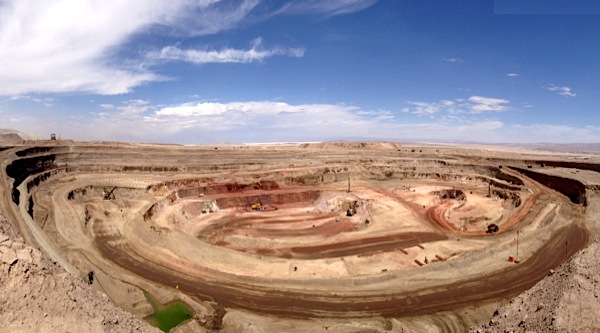
About 20% of Chile’s largest copper mines closed or reconverted by 2025

Close to 20% of Chile’s largest copper mines will be closed or reconverted by 2025, as the country faces a challenging scenario, marked by falling ore grades at its aging mines, sliding copper price and rising costs.
While the country produced 5.8 million tons of copper last year, 20% of that figure (1.2 million tons) came from operations that are facing closure or conversion in the next 10 years.
According to local paper El Mercurio (in Spanish), while the country produced 5.8 million tons of copper last year, 20% of that figure (1.2 million tons) came from operations that are facing closure or conversion in the next 10 years.
But there is a way out for the world’s largest copper producer, which also holds the largest reserves of the red metal. The key seems to be investing in reconversion projects focused on mining sites redevelopment to create new commercial possibilities.
The problem, notes the article, is that most miners believe now is not the best time to start such projects. What is worse: carrying on current activities may make them even more difficult to execute in just a couple of years.
Some official figures reinforce the pessimism. According to the country’s Mining Council, 43% of the global copper producers will be generating higher ore grades than Chile by 2020.
$105 billion to the rescue
But according to the Chilean Copper Commission (Cochilco), investments are picking up and will provide the sector the push it needs. The mining industry, says the body’s latest report, will invest $105 billion in mining projects across the country between 2014 and 2023.
Of the total investment, $81 billion are set to go towards the copper industry, while $23 billion will be used for gold, silver, iron ore another industrial mineral projects.
The massive investment will also include $28 billion in allocated funds for Codelco, the state-owned copper mining company, for new mines and the expansion of one of its major projects.
No trust issues
“Certain projects are currently facing delays,” Cochilco executive VP Sergio Hernández told Business News Americas last month.
The reasons for some projects to be running behind schedule, he said, are a mix of delays in securing permits and difficulties meeting new environmental and social standards.
About 20% of Chile’s largest copper mines closed or reconverted by 2025
Panoramic of  Codelco's new 160,000 tonnes-plus Ministro Hales mine.
He also noted that a number of projects included in last year's portfolio have since gone online. These include Codelco's Ministro Hales, Lumina Copper's (CVE:LCC) Caserones and KGHM International's (TSX:QUX) Sierra Gorda mines.
“There are no trust issues here; mining investors are confident. No project has fallen through,” Hernández added.
Mining investments in Chile will feature 14 companies that are looking to implement medium or large-scale mining projects in the country for the first time, according to Cochilco’s report.
The planned investment will also include nine new mining projects with an estimated investment of $8.9 billion, seven of which are copper operations.
Cochilco said once all projects are completed, the country’s copper production would exceed 6 million tons by 2015 and 8 million tons by 2025. Gold production is expected to rise as well, increasing by 191% to 149,480kg a year.

Sunday, September 7, 2014

Why to trade in Nifty Future instead of Stock Future

Why to trade in Nifty Future instead of Stock Future
Here is my reasoning.
  1. You do not have to diversify with multiple stocks for equity exposure, the index is already diversified.

  2. The risk of any one stock having something catastrophic happen will not really hurt your trade. No one stock has more than a 3% weighting. 

  3. The Nifty Future  is much harder to manipulate than individual stocks due to its size and volume of trading.

  4. Nifty Future move much more smoothly around support and resistance areas than most individual stocks.

  5. Nifty 50 has its own survivor bias replacing it holding of falling stocks with new ones that are growing in market capitalization.

  6. You do not have to deal with earnings surprises like in individual stocks.

  7. Due to the indexes much lower volatility you can trade larger position sizes with much less risk.

  8. The Nifty options are very liquid with very tight big ask spreads.

  9. With this index you can trade the trend of the stock market itself which is a much broader bet than any one company or sector.

  10. Margin required for trading Nifty Future is quiet less as compared to Stock Futures

Nifty 2014 based on 2009 Election move

Using the Similarity in Price Action of Year 2009 we are trying to analyse the way forward for Nifty in remaining of 2014

Bulls have been riding the Dalal street from Feb Month and got in momentum after May 16 election results. Analyst on Streets have been talking about 8500/9000 odd levels and every dip coming in market is getting bought into.
I tried to analyse the chart of Nifty from 2009 after election results and interesting study came out.
After 2009 election as seen in below chart Nifty saw 2 UC’s followed by a period of upward sloping from consolidation between two trend-lines and then the upside breakout. The post pattern above the breakout resulted in move towards 123.6% of the channel width which formed an important top @ 6336 and than 1000 point correction in Nifty.
Post 20092014 Scenario
In 2014 scenario also after the rise on 16 May Nifty is trading in sharp rise on Election result day followed by period of upward sloping consolidation with an upside breakout. So if we are applying the Election time concept properly  the upside target projecting 100 % of channel @ 8240 and in maximum case  123.6% of channel will come near 8340. So except some major top to be formed in this range and we can expect a decent correction.
2014 Post

Gann's Financial Table Still Working

Gann did respect cycles. The cycles of human nature, boom bust boom, so where are we now based on Gann Financial Calendar.
Learn more about Gann here.
The funny tihng is that the table below was built before 1930s, and like any cycle study it tends to correlate well most of the time. The last 20 years it gets a mark above 80% so it worth 60 seconds of your life to learn about it. Like many living cycle master today, many are forecasting doom over the next few years (Charles Nenner, Martin Armstrong, Dan Ferrera) and the Gann Financial Calendar is no different.
Hey, if you see clouds on the horizon, you do tend to get rain!
Gann's Time Table Updated and Adjusted for Current Times
Matched to the SP500
Matched to the S&P500
NOTE: readtheticker.com does allow users to load objects and text on charts, however some annotations are by a free third party image tool named Paint.net
Investing Quote...
"After exhaustive researches and investigations of the known sciences, I discovered that the Law of Vibration enabled me to accurately determine the exact points to which stocks or commodities should rise and fall within a given time. The working out of this law determines the cause and predicts the effect long before the Street is aware either." ~ William D Gann
"Markets are constantly in a state of uncertainty and flux and money is made by discounting the obvious and betting on the unexpected." ~ George Soros

Stocks Have Reached A Permanently High Plateau

Stocks Have Reached a Permanently High Plateau  
A permanently high plateau of stock prices is a marvelous innovation.
Somebody said this before, of course, but one glance at a chart of the S&P 500 tells us that stock prices have
reached what looks like a permanently high plateau
. How can we identify a
permanently high plateau? One sign is price never touches the 50-week
moving average (MA), much less the 200-week MA: prices just keep
marching higher in a volatility-free permanently rising plateau.
It's almost like a film set, where the special effects department (i.e. the Financial Singularity) has been called in to get rid of pesky volatility and fluctuations.
Memo to Head Office: Done. The MACD indicator has been locked into a permanently high plateau as price marches higher in an orderly fashion.
A permanently high plateau of stock prices is a marvelous innovation: you can practically set your watch to the steady tick of new all-time highs, and all you need to plan your retirement or cash-out of your stock options is a ruler and a pencil--just extend the price line as far forward as you want, and calculate your wealth.
The only downside of this permanently high plateau of stock prices is that it eliminates the need for the financial punditry and the workforce of money managers. With bearish influences and volatility both eradicated, there is nothing left to talk about except the upward slope of the permanent plateau.
Stocks Have Reached A Permanently High Plateau
As for money management--for most people, there's no need to play around trying to beat the index by a tiny percentage: just lock your money up in a index fund and watch it grow, month after boring month, year after boring year.
The Federal Reserve's testimony to Congress will be boringly predictable: "stock prices continue to rise in an upward sloping permanently high plateau." Congress and the Fed will congratulate their outstanding management of the economy, and once behind closed doors, congratulate the Special Effects crew for their fine work maintaining the permanently high plateau.
Our permanently high plateau of stock prices greatly simplifies life. If you own enough of the stock market, you can calculate your wealth next year and order a new private jet right now, because you know you'll be $25 million richer by then.
And of course the economy will thrive on this steadily rising permanently high plateau because those new private jets will need to be manufactured and maintained, and small airports in wealthy enclaves will need to add space for the new private jets.
Let's face it: this permanently high plateau of stock prices is financial nirvana. Permanently high plateau has such a nice ring to it, doesn't it? Let's say it three times just for the pleasure of the alliteration: permanently high plateau, permanently high plateau, permanently high plateau.
Sourced from Charles Hugh Smith from Of Two Minds

INFOGRAPHIC: A forecast of when we'll run out of each metal (Commodities)

Here is one interpretation of when we’ll run out of each metal or energy source. While the technicalities of some of this information can be debated, I think the general theme runs the same. There is a limited supply of these commodities – and if there are no discoveries, no price changes, and no changes in consumption, we are running out relatively soon. In my opinion, there are two caveats that are always worth considering when looking at something like this.
1. “Reserves” are an engineering number that are based on economic viability. Technically speaking, there are small concentrations of gold everywhere. It is just not usually viable to mine 0.1 g/t gold. When we will “run out” of each mineral in this chart is based on current reserves and prices. If the gold price doubles, then suddenly it is economic to mine more.
2. This chart is a reminder that something has to give. Either prices are going to have to go up, or new amazing discoveries have to be made to keep prices down. It’s basic economics, and either way it seems that there are many opportunities in the mining industry for investors and speculators on both fronts.
A Forecast Of When We'll Run Out of Each Metal

Saturday, September 6, 2014

Here's Why The Market Could Crash - Not in Two Years, But Now

Markets crash not from "bad news" but from the exhaustion of temporary stability.
Yesterday I made the case for a Financial Singularity that will never allow stocks to crash. We can summarize this view as: the market and the economy are not systems, they are carefully controlled monocultures. There are no inputs that can't be controlled, and as a result the stock market is completely controllable.
 
Today I make the case for a crushing stock market crash that isn't just possible or likely--it's absolutely inevitable. The conceptual foundation of this view is: regardless of how much money central banks print and distribute and how much they intervene in the markets, these remain complex systems that necessarily exhibit the semi-random instability that characterizes all complex systems.
 
This is a key distinction, because it relates not to the power of central banks but to the intrinsic nature of systems.

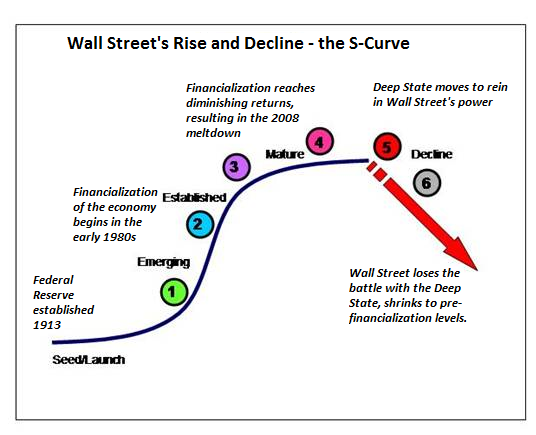
One of the primary motivators of my work is the idea that systems analysis can tell us a great deal about the dysfunctions and future pathways of the market and economy. Systems analysis enables us to discern certain pathways of instability that repeat over and over in all complex systems--for example, the S-Curve of rapid growth, maturation and diminishing returns/decline.
 
One ontological feature of complex systems is that they are not entirely predictable. An agricultural monoculture is a good example: we can control all the visible inputs--fertilizer, seeds, water, pesticides, etc.--and conclude that we can completely control the output, but evolution throws a monkey wrench into our carefully controlled system at semi-random times: an insect pest develops immunity to pesticides or the GMO seeds, a drought disrupts the irrigation system, etc.
 
The irony of assuming that controlling all the visible inputs gives us ultimate control over all outputs is the more we centralize control of each input, the more vulnerability we introduce to the system.
Those arguing that central banks (and their proxies) can control the stock market have the past six years as evidence. Those of us who see this heavy-handed control as increasing the risk of unpredictable instability have no systems-analysis model that can pinpoint the dissolution of central bank controlled stability. As a result, we seem to be waiting for something that may never happen.
 
Despite its inability to predict a date for the collapse of stability, I still see systems analysis as providing the most accurate and comprehensive model of how complex systems function in the real world. If the economy and the market are indeed systems, then we can predict that any level of control will fail no matter how extreme, and it will fail in an unpredictable fashion that is unrelated to the power of the control mechanism.
 
Indeed, we can posit that the apparent perfection of central-bank engineered stability (i.e. a low VIX and an ever-rising market) sets up a crash that surprises everyone who is confident that central-bank monocultures never crash. In the real world, manipulated stability is so vulnerable to cascading collapses that crashes are probabilistically inevitable.
 
That raises the question; why not crash now? After all, all the good news is known and priced in, and all the bad news has been fully discounted. Why shouldn't global stock markets crash big and crash hard, not in two years but right now?
 
Markets crash not from "bad news" but from the exhaustion of temporary stability. The longer that temporary stability is maintained by manipulation, the greater the severity of the resulting crash.
 
As I noted in The Coming Crash Is Simply the Normalization of a Mispriced Market, this line from songwriter Jackson Browne captures the ontological falsity of permanent market stability: Don't think it won't happen just because it hasn't happened yet.

"Printed" Money For Nothing

World GDP growth expectations just hit their lowest in two years... and stocks didn't
"Printed" Money For Nothing

Friday, September 5, 2014

Nickel hits 7-week high as Philippine news spurs speculators

Nickel hits 7-week high as Philippine news spurs speculators
Nickel prices climbed to their highest in seven weeks on Thursday as speculators returned to the market on worries that the Philippines could follow Indonesia in banning unprocessed ore exports.
Three-month nickel on the London Metal Exchange soared to a session high of $19,498 a tonne, its strongest since July 14, driven by buying from commodity trading advisers (CTAs) and macro funds, traders said.
The metal later pared gains to end at $19,395 a tonne, up 1.7 percent. It is up nearly 40 percent so far this year.
Nickel hit a 27-month peak of $21,625 a tonne in May after top exporter Indonesia banned unprocessed ore shipments to stimulate its domestic processing industry.
Prices jumped 2.8 percent on Wednesday on the news that a Philippine senator had proposed a ban on raw materials exports. 
"We've taken away Indonesian nickel ore and if you also take away Philippines as well, you can wave goodbye to the nickel pig iron (NPI) industry in China," said Nic Brown, head of commodities research at Natixis in London. "So this is clearly a big deal. That's why the market is taking it so seriously."
After nickel's May peak, prices drifted lower and many speculators closed long positions, but the market is likely to extend gains as they re-enter the market, Brown said.
"We expected to see prices above $20,000 a tonne at some point in Q4 going into Q1 next year. But we could get there rather sooner than we expected and even $25,000 is not unreasonable if you take Philippine ore out of the equation."

COPPER GAINS
Copper rebounded from two-week lows and other metals also rose after the European Central Bank cut interest rates to new record lows to support the stagnating euro zone economy. 
More accommodative monetary policy could free up liquidity for industry and investors, supporting metals prices.
ECB President Mario Draghi said if inflation looked like staying too low for too long, the ECB Governing Council was unanimous in its commitment to using other "unconventional instruments" - a phrase taken as code for printing money as the U.S. Federal Reserve and Bank of England have. 
LME copper closed 0.4 percent higher at $6,930 a tonne after falling 1 percent in the previous session when it reached a two-week low of $6,882 a tonne.
Dimming copper's price prospects, however, were mine supply bottlenecks being cleared and beginning to feed into the market.
Newmont Mining Corp signed a deal with Indonesia that will allow for the resumption of copper concentrate exports next week, the head of the firm's local unit said, ending an eight-month tax dispute.
Aluminium closed 1.3 percent higher at $2,105 per tonne, zinc ended 1.4 percent higher at $2,398 per tonne, lead closed 0.8 percent higher at $2,225 per tonne and tin closed 0.7 percent higher at $21,500 per tonne.

Zambia abandons the emotive rule on copper exports

Zambia abandons the emotive rule on copper exports
From September 8th, the rule which instructs the companies to submit documents from destination countries in order to receive tax refunds, will be no longer required. This will end the cat fight over the 600 million dollars, gathered tax refunds, which have been a threat to Zambia’s mining industry.
The announcement was made just a few days after the chamber of mines notified that most of the copper mining companies in the country are facing a harsh financial crisis due to the blockage of tax refunds from the government, which is creating deficiencies in output and also alarming job cut offs in the country.
Ivan Glasenberg, the chief executive of Glencore stated that, the deduction would help to strengthen the company’s expectations to expand the company’s unit in Zambia. Glencore is planning an expansion worth 323 million dollars at the company’s Nkana copper mine, which would extend the lifetime up to a time period of 30 years.

Copper demand in China hangs on the power sector

Copper demand in China hangs on the power sector
Last year, more than half of copper demand of China came out from its power sector, but this year there has been a decline. The constant diminishing of the demand in power sector might cut down the rate of China’s import, which is a determining factor in international market prices.

According to the industry sources, this year, the investment in power sector had been expected to gain a 10 percent hike, but instead the sector had to cope with .6 percent drop in the investment compared to last year’s demand; shows the reports of China Electricity Council.
A senior analyst of Antaike Information Development Co; a state supported research firm, Yang Changhua stated that if there would be no rise in the investment of power sector, the consumption forecast of the 2014 should be adjusted down. The research firm had already forecasted the country’s copper consumption, which said that the consumption would have 6.7 percent hike, which will be an increase of 8.7 million tones.
The dominant in the investments in power networks in the country, the State Grid Corp of China stated that, it was being audited in May, and catching this phrase, industry source states that, the reason behind the sudden decline of demand in the power sector might be due to the audit, of which the reason is still unknown.  

Goldman Sachs: Gold will drop $200 by end of year

On the Comex division of the New York Mercantile Exchange, gold futures for December delivery on Thursday continued to drift lower, trading at a near 3-month low.
In afternoon trade gold was changing hands for $1,266.00 an ounce, down more than $4 an ounce compared to yesterday's closing price.
The latest retreat in the price pares the metal's gains for the year to under 5%.
The 2014 low for gold is $1,244 reached June 2, but many analysts believe the gold price has much further to fall.
On Thursday Goldman Sachs said it's sticking to its original forecast of gold at $1,050 an ounce by the end of the year.
CNBC quotes chief commodity strategist at the investment bank Jeffrey Currie as saying safe haven buying on the back of the Iraq and the Ukraine-Russia crisis and money printing due to economic weakness in Europe and Japan have been supporting gold somewhat, "but prices are being pressured by Federal Reserve policy."
"Our target at the end of this year is $1,050, really driven by the view that we think that the Fed will ultimately be the dominate force here and put more downward pressure [on prices]," Currie told CNBC's "Squawk Box" on Thursday. "Gold is a hedge against a debasement in the U.S. dollar." He said he'd recommend shorting gold.

Thursday, September 4, 2014

Nickel surges on Philippine ban proposal, options expiry

* Philippine senator urges unprocessed ore export ban
* Nickel options expiry helps boost prices-analyst
* Tin falls to lowest level since January

Nickel prices jumped to a four-week high on Wednesday on news that a Philippine senator had urged a ban on unprocessed mineral ore exports and also following an options expiry in London.
 
Copper fell on higher exchange stocks and as investors downplayed signs of progress towards peace in eastern Ukraine while tin slid to a eight-month low on worries about oversupply.
 
Three month nickel on the London Metal Exchange raced 2.8 percent higher to close at $19,075 a tonne, the highest since Aug. 7.
 
Prices, which are up by around one-third in the year to date, were bolstered by news that a Philippine senator had filed a bill urging a halt to exports of unprocessed mineral ores. 
 
The proposed halt is similar to a ban introduced by Indonesia from January that led to a sharp spike in nickel prices and cut other ore exports.
 
Most analysts expect a deficit in nickel next year, and so the Philippines news worried investors, but some analysts were wary of the gains since.
 
"This is one senator introducing what we would call a private members bill. It's far too early to say whether it will gain traction," BNP Paribas analyst Stephen Briggs said.
 
Analyst Edward Meir at broker INTL FCStone was also sceptical. "Instituting a ban will result in foregoing massive amounts of revenue, not to mention the fact that buyers may very well have found other suppliers in the interim," he said in a note. "We would therefore not be jumping on this particular rally in nickel."
 
Many investors have been exposed to nickel through the options market, and the expiry of September options was also a factor in the surge in prices, analyst Leon Westgate at Standard Bank said.
 
"With options declaration rolling off, some of the recent gravitational pull of the $18,500 level has vanished," he said in a note.
 
Open interest in September call options was concentrated at the $18,500 strike. 
 
 
OTHER METALS SLIDE
 
In other metals, copper slid 1 percent to finish at $6,904 a tonne, its lowest level in two weeks. Prices have struggled to gain headway in recent weeks as expectations of fresh supply have dampened investor interest.
 
Daily LME data showed stocks rose by 7,000 tonnes to 154,825 tonnes, their highest since July 22 after two weeks of near straight increases. 
 
"Copper took a hit when LME stocks (data) came out. If the surplus is going to become more visible through exchange stocks, that would be meaningful. It's too early to say," Briggs said.
 
Markets were wary of news about the Ukraine conflict.
 
Russian President Vladimir Putin said a deal to end fighting in eastern Ukraine could be reached this week, but hopes of peace were clouded by Western concerns that the announcement was timed by the Kremlin to wrong-foot NATO on the eve of a summit.
 
"This news about Russia and Ukraine, the immediate impact you're more likely to see through oil andprecious metals for one, and secondly, it's not clear what it means," Briggs said.
 
Some investors hoped for further policy action at the European Central Bank meeting on Thursday after data showed euro zone retail sales slowed in July, while business activity grew at the slowest rate this year in August. 
 
Looser policy in Europe would cheapen liquidity for industry and investors, who may raise their holdings of hard assets, which tend to hold their value when paper currency depreciates.
 
Aluminium shed 1.3 percent to end at $2,079 a tonne, moving away from last week's high above $2,100, which was the most expensive since February 2013.
 
A partial closure of capacity at an aluminium smelter in China helped drive up domestic prices of the metal by as much as 4 percent this week as investors scramble to compensate for an expected shortfall in supply.

Caroline Bain, senior commodities economist at consultancy Capital Economics, said its forecasts for aluminium had recently been revised.
 
"We are anticipating a small deficit of just over 100,000 tonnes this year, but we have the market back in surplus next year as we expect China's production to keep growing," she told the Reuters Global Base Metals Forum.
 
Zinc closed 0.5 percent weaker at $2,365 a tonne, having struck a four-week top of $2,391.25 in the prior session, while lead shed 1.4 percent to $2,208.
 
Tin fell 0.8 percent to end at $21,350, the lowest level since January, as analysts and investors scratched out their previous forecasts of a deficit this year due to more supplies than expected and soft demand.

"God of Crude Oil Trading" Goes All In On Crude At $150 Bet

Andy Hall - known as the God of Crude Oil Trading to some of his peers - has, according to Bloomberg, built his success on a simple creed: Everyone who disagrees with him is wrong. He was one of the few traders who anticipated both the run-up in and the eventual crash of oil prices in 2008. Hall has made billions for the companies for which he’s traded by placing one aggressive bet after another; and now, he is all-in again.Hall is going all in on a bet that the shale-oil boom will play out far sooner than many analysts expect, resulting in a steady increase in prices to as much as $150 a barrel in five years or less. As one industry CEO warned, "anybody who bets against Andy Hall might be making a poor bet."
“When you believe something, facts become inconvenient obstacles,” Hall wrote in April, taking issue with an analyst who predicted a shale renaissance could result in $75-a-barrel oil over the next five years.

Hall is going all in on a bet that the shale-oil boom will play out far sooner than many analysts expect, resulting in a steady increase in prices to as much as $150 a barrel in five years or less.

Investing ever-larger sums of his own money, he’s buying contracts for so-called long-dated oil, to be delivered as far out as 2019, according to interviews with two dozen current and former employees and advisers who are familiar with Hall’s trading but aren’t authorized to speak on the record. To attract buyers, the sellers of these long-dated contracts -- typically shale companies that have financed the boom with mounds of debt -- need to offer them at a discount to existing prices.
Hall's reasoning...
...he digs deep, delving into the minutiae of how Texas discloses oil production, the tendency of some shale wells to play out quickly and the degree to which the boom has relied on debt. The simplest of his reasons, though, is that producers have already drilled in many of the best areas, or sweet spots. Hall predicts that growth in shale output will begin to moderate this year and U.S. production will peak as soon as 2016.

“Once those areas have been drilled out, operators will have to move to more-marginal locations and well productivity will fall,” Hall wrote in March. “Far from continuing to grow, production will start to decline.”
How Andy Long does it...
"God of Crude Oil Trading" Goes All In On Crude At $150 Bet
But not everyone agrees...
“We haven’t scratched the surface,” Hall’s former mentor O’Malley says. “There are massive additional shale fields in the United States. Technology does tend to move forward.”

...

Predictions of $75 oil, espoused by Citigroup oil analyst Edward Morse in a Barron’s story in March, really bug him, according to those who know his thinking.

“We are not sure what supports his conviction,” Hall wrote of the analyst’s theories in his June newsletter, although he didn’t identify Morse by name. “It is apparently not facts or analysis.”

The shale revolution faces political, environmental and technical hurdles in other parts of the world that will stall its rollout, Hall wrote. Morse, who also correctly predicted the sharp rise in crude prices in the past decade, says Hall has let his admiration of peak oil theorists cloud his judgment.

“It took a long time for believers in the Cold War to admit it was dead. So, too, is it taking a long time for peak oil believers to admit that it is dead,” Morse says.
So far this year, he appears to be getting confirmation...
So far this year, there are signs that he may be on the right track. In North Dakota’s Bakken and Texas’ Eagle Ford formations, which have accounted for almost all of the jump in U.S. output, the combined year-over-year growth in production in July fell below 30 percent for the first time since February 2010.

Two central questions about technology and shale will likely determine the outcome for Hall: how many wells producers will be able to drill in a finite amount of land that sits atop oil-bearing layers of rock and whether the U.S. renaissance will be repeatable abroad. Hall is betting no on both counts. Morse, and many in the energy world, are betting yes.
Timing is everything...
“He’s a phenomenal trader,” says David Neuhauser, a money manager at Livermore Partners who has followed Hall’s progress as an Occidental shareholder. “I believe he’s right about long-term prices; we’re in the same camp. What I don’t know is how long it will take for the market to catch up.”
*  *  *
Russia would sure be happy itf Andy Long is right... USA not so much... perhaps that is the crucial factor in this manipulated market that overpowers everything?