Tuesday, July 8, 2014

Dow Loses 17,000; Catches Down To Bonds

We warned Thursday that there was something wrong with the picture of the equity market's exuberance but it seems the July-4th-week-effect has run its course and equity markets - having read the jobs report over the weekend - have realized it is anything but strong. The Dow just lost 17,000 (however briefly) and equities are catching down to Treasury yield's drop as USDJPY loses 102.00.

Dow loses 17k...
Dow Loses 17,000; Catches Down To Bonds

as Stocks catch down to bonds...
Dow Loses 17,000; Catches Down To Bonds

Charts: Bloomberg

Monday, July 7, 2014

Weekly Economic Data for the week 05-Jul-14 to 11-Jul-14

Weekly Economic Data for the week 05-Jul-14 to 11-Jul-14

Avg. change of last 1 year: Average Change in Actual data calculated for last 1 year.
Expected impact on price: This indicator shows the effect of the anticipation of data on the prices of related country’s major indices. We have categorized it as below:
Very Good Good Neutral Bad Very Bad
Actual: Refers to the actual/latest figures after its release.
Data for the week 05-Jul-14 to 11-Jul-14
Date Time (IST) Country Data Exp. Prior Exp. chg today Avg. chg of last 1 year Exp. Impact on Price
07-Jul-2014 06-00 AM Japan BOJ Governor Kuroda Speaks at Branch Manager Meeting         Neutral
07-Jul-2014 11-30 AM Germany Industrial Production s.a. (MoM) 0% 0.20% -0.20% 2.36 Neutral
 
08-Jul-2014 09-15 AM Japan BOJ Deputy Governor Nakaso Speaks in Tokyo         Neutral
08-Jul-2014 12-30 PM European Monetary Union EU Finance Ministers Hold Meeting         Neutral
08-Jul-2014 02-00 PM United Kingdom Industrial Production (MoM) 0.3% 0.4% -0.10% 1.75 Neutral
 
09-Jul-2014 07-00 AM China Consumer Price Index (YoY) 2.4% 2.5% -0.10% 0.43 Neutral
09-Jul-2014 07-00 AM China Producer Price Index (YoY) -1.0% -1.4% 0.40% 0.61 Neutral
09-Jul-2014 08-00 PM United States EIA Crude Oil Stocks change -- -3.15 3.15 3.45 Neutral
09-Jul-2014 11-30 PM United States Fed Releases Minutes from June 17-18 FOMC Meeting         Neutral
09-Jul-2014 11-30 PM European Monetary Union ECB President Mario Draghi speaks in London         Neutral
 
10-Jul-2014l -- China Imports (YoY) 5.6% -1.6% 7.20% 6.92 Neutral
10-15 Jul-2014 -- China Money Supply M2 YoY 13.5% 13.4% 0.10 0.71 Neutral
10-15 Jul-2014 -- India Exports YoY   12.4%   4.06 Neutral
10-Jul-2014 -- China Exports (YoY) 10.2% 7.0% 3.20% 5.65 Neutral
10-Jul-2014 -- China Trade Balance 36.95B 35.92B 1.03 13.34 Neutral
10-Jul-2014 01-30 PM European Monetary Union ECB Publishes Monthly Report         Neutral
10-Jul-2014 04-30 PM United Kingdom Bank of England Bank Rate 0.5% 0.5% 0.00 0.00 Neutral
10-Jul-2014 08-00 PM United States EIA Natural Gas Storage change -- 100 -100.00 33.60 Neutral
 
11-Jul-2014 02-00 AM United States Fed's Fischer Speaks on Finance Sector Reform in Cambridge, MA         Neutral
11-Jul-2014 03-30 PM European Monetary Union ECB Announces 3-Year LTRO Repayment         Neutral
11-Jul-2014 05-30 PM India Industrial Production YoY -- 3.4%   2.08 Neutral


Global Nickel market to see deficit in 2015-'17: Eramet

Global Nickel market to see deficit in 2015-'17: Eramet
The French mining and metallurgy major Eramet predicts the global nickel market to remain in deficit during 2015-2017 if Indonesia persists with the ban on exports of unprocessed nickel. The company CEO Bertrand Madelin expressed the view while speaking at a company news conference in Tokyo.


According to the company, stocks of nickel ore at Chinese ports are likely to reach lower levels by the end of this year. The world nickel market will end up in slight deficit by end-2014. The Chinese stock levels are likely to deplete owing to the ongoing Indonesian export ban. The global nickel market had reported nearly 150,000 mt of surplus in 2013.

The company foresees the global nickel market to end in real deficit by 2015 on continuing Indonesian ban. A similar ban from Philippines is likely to add to deficit-woes, added Madelin.

Eramet is a French multinational mining and metallurgy company, listed on the Euronext Paris exchange. The company produces non-ferrous metals and derivatives, nickel alloys and superalloys, and high-performance special steels. Through its subsidiary Société Le Nickel, the company has its historical roots in nickel mining, and for over 100 years has maintained a large mining operation in the French overseas territory of New Caledonia. It is also a major producer of manganese from mines in Gabon.

China's May Lead imports drop; Alloy imports hold up

 China's May Lead imports drop; Alloy imports hold up
China only imported 6 tons of refined lead in May, Customs data show, as lead supply in China was ample and import prices for the metal were considered high.
The import volume in the first five months of this year slumped 80.46% year-on-year to 94 tons.
Lead alloy imports, in contrast, hit 1,740 tons in May and amounted to 13,000 tons for the first five months of the year, boosted by robust demand at home.

Food inflation - Since QE3, Breakfast Is Up Over 24%

Having pointed out the 'surges' in the cost of your 4th of July burger at the behest of Greenspan and Bernanke, we thought a reflection on the soaring costs of 'the most important meal of the day' were in order. As the following chart illustrates in words and pictures even a PhD Fed economist or CNBC pretend-economist could understand - food-inflation is here from breakfast through dinner (no matter how many iPads we try and eat).

Food inflation - Since QE3, Breakfast Is Up Over 24%

Sunday, July 6, 2014

What's Your Trading Brain Type ?

Five Types

To summarize, there are five general brain types. Among traders and investors, the three most important brain types are Compulsive, Impulsive and Anxious.
What's Your Trading Brain Type ?
Left Brain - Right Brain
People with Compulsive Brains tend to get stuck in a particular thought about the market. “It’s too high.” “It’s too manipulated.” “It’s too risky.” It’s too…” whatever. People with Compulsive Brains tend to operate entirely on their own terms and are generally not open to feedback or other options.  
People with Impulsive Brains are the exact opposite. They are unpredictable and lack impulse control in trading/investing and in daily life. Without much discipline, they start many more projects than they finish. They live for creativity and for what’s possible.
People with Anxious Brains live with a rain cloud overhead.  They pay more attention to the obstacles to their own success (or the success of others) than to the ways that something might work. They don’t like to try new things and don’t appreciate novelty.
The fourth type is the Depressed Brain. These people tend to feel victimized by the market. They have a ‘Rodney Dangerfield’ mentality, believing that they never get a break or a fair shake. They blame the Fed, the robots, the news, company management, or whatever for their investing and trading troubles. This type of thinking rationalizes and justifies their pre-existing mood.   
The fifth type is a combination of Compulsive and Impulsive. These folks tend to be compulsively impulsive, which may mean that they have an addictive relationship to the market and to trading. They overtrade because they are trading-to-trade, like a mouse pressing a lever to generate pleasure signals in their brains.

Free Quiz

If you are curious about your brain type, you may download a free Brain Type Self-Assessment HERE.
What's Your Trading Brain Type ?

McClellan Sounds "Alarm" Over Stock Market Drawdowns


Alarming Sign in NDX Stocks’ Drawdown

Chart In Focus
July 03, 2014
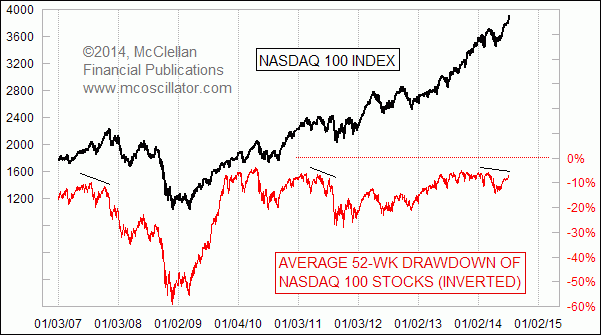
The Nasdaq 100 Index is making new multi-year highs, levels not seen since the weeks just after the 2000 Internet Bubble top.  But it is interesting for us to see that the average component stock in that index is down 7% from its trailing 52-week high. 
And that 7% drawdown number is actually smaller than it has been recently, but it is still not back to the low drawdown reading of 6.0% that we saw in early March, before the Nasdaq 100 stocks got into a patch of trouble.  And the fascinating point is that divergences like this tend to be really important for the long-run picture for stock prices.
This current divergence is not guaranteed to stay with us.  It looks like a genuine divergence now, but it is still possible that we could see a continued rally that takes the stocks in the Nasdaq 100 collectively up closer to the level of their 52-week closing highs, thereby closing the gap on this measure of average drawdown.  But for now, the message is that the average stock making up the Nasdaq 100 Index is not confirming the bullish message of the NDX’s higher price highs. 
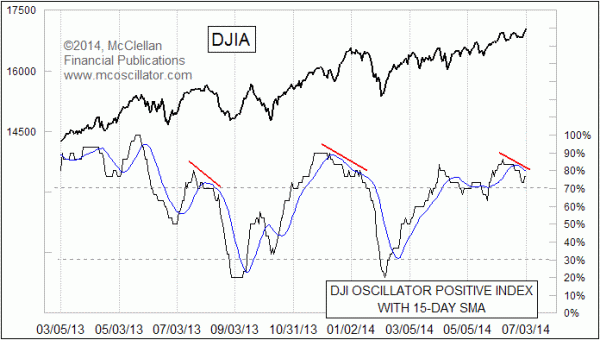
A similar message comes from a similar indicator, this time examining the 30 stocks which make up the DJIA. 
DJI Oscillator Positive Index
This one looks at the 30 stocks that make up the DJIA, and checks each one to see if its Price Oscillator is above or below zero.  What we are seeing lately is a declining number of Dow components participating in the uptrend that way, and a drop of this indicator below its 15-day moving average.  This condition also comes as a divergence appears between prices and the indicator.
As with the NDX stocks’ indicator above, the divergence does not absolutely have to persist; the market could just power through it, but that is not usually the way things usually work out.
Via Tom McClellan via NTMarkets