Thursday, June 26, 2014

CHARTS: Gold price entering make or break territory

The gold price jumped around on Wednesday only to settle in familiar territory.
On the Comex division of the New York Mercantile Exchange, gold futures for August delivery in late afternoon trade exchanged hands for $1,319.50 an ounce, down $1.80 from its settlement level in middling volumes.
Earlier in the day gold touched a low of $1,305.40, only recovering after a drop in the dollar following a surprisingly large down adjustment in the first quarter US GDP.
Last Thursday's nearly $50 an ounce surge in frenzied trading now appears to have been a blip as gold's momentum turns sideways.
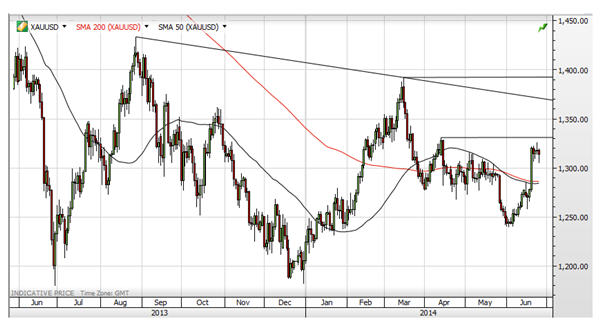
Ole Hansen, Head of Commodity Strategy at Denmark's Saxo Bank, says for gold to continue to show strength the metal must first clear $1,331:
If successful it should be able to make further progress towards trend-line resistance at 1371 USD/oz ahead of the 2014 peak at 1392 USD/oz. However, a move back below 1300 USD/oz would remove the current momentum and most likely result in a renewed period of range-bound trading around 1295 USD/oz. which has been the average price for the past year.
CHARTS: Gold price is entering make or break territory
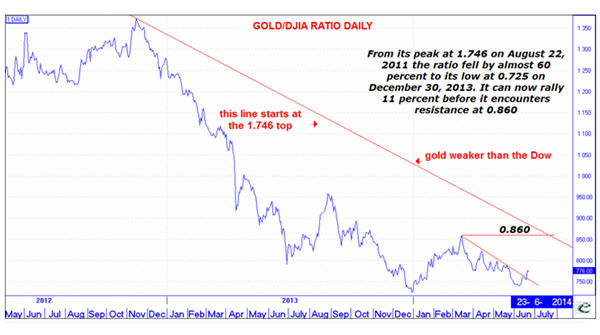
Technical research and investment blog InvesTRAC's chart of the gold price versus the blue-chip Dow Jones Index, which on Wednesday was again toying with record territory despite the GDP numbers, indicates that gold is set to outperform stocks:
The long term downtrend from the top at 1.746 is still intact…the recent weakness held above the 0.725 low and the ratio has now pushed up through the first downtrend which opens the way for an 11 percent rally to the next visible resistance at 0.860. If the ratio can get through this barrier it would suggest that after an almost 60 percent decline it would have the potential to go substantially higher:
CHARTS: Gold price is entering make or break territory
FLASHBACK:
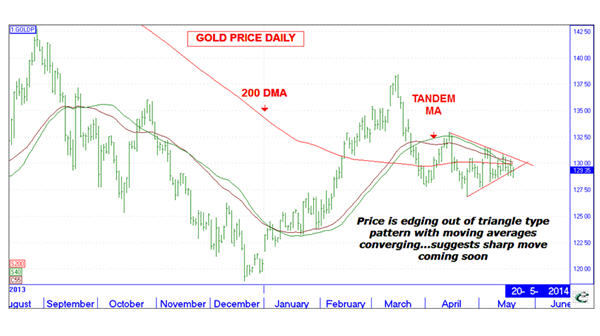
Towards the end of May, InvesTRAC produced a chart showing that the uncharacteristically quiet gold market was primed for break-out price move. That bust out if its trading range started out as a big gap down with the gold price hitting $1,244 at the start of June. That was before Yellen and ISIS changed the picture again and a 90 tonne 15-minute trade lit a fire under the metal.
CHARTS: Gold price is entering make or break territory

Visualizing The Five Reasons To Own Gold

Following last night's 94-page extravaganza on goldthis infographic, part four in our 2014 Gold Series (part 1, part 2, & part 3 here), covers the five best reasons to own gold: 1) Gold helps investors diversify their portfolios; 2) Gold is a great store of value; 3) Gold helps protect against inflation and other risks; 4) Gold demand is driven by a growing east, while grades are dropping and new discoveries are more scarce; and 5) Gold stocks are as cheap as they have ever been, using the GDX as a proxy. The reasons to own gold have not changed since the peak in 2011.

Citi Warns US Equities Are Facing A Pullback

US equity indices are showing signs that a pullback may be developing, Citi's FX Technicals group notes, as the S&P 500 Index, the NASDAQ Composite Index and the Dow Industrials Index all posted bearish key days yesterday. A short-term correction on the order of 3%-6% may be developing on the back of this.
The Dow Transports Index, which has been the leading US equity Index this year, has already been showing signs of stress as well. The VIX Index is also turning higher from low levels and should head up towards at least 14% if not 18% if the pullback in equities materializes.

Citi Warns US Equities Are Facing A Pullback

The US S&P 500 Index posted a bearish key day at the trend highs yesterday. (The last bearish key day at trend highs back in April was followed by a high to low move of -4.4%.) Daily momentum also turned lower and negative momentum divergence has developed (though not triple divergence).
A short-term pullback towards supports around 1920-1925, the converging channel bottom and recent low, appears likely at this point. A break below there then opens the way to good supports around 1900, which would result in a high to low correction of around 4%.
At this point our bias is that a short-term pullback to the above supports would not be out of line within the overall trend higher (markets don’t move in straight lines after all). However, a deeper correction, which is not yet our base case, could see a pullback towards the 1814-1820 area (converging April low and 200 day moving average, which has not been tested since 2012).
Other equity markets are also showing signs of stress.

Ceiling, floor prices

Ceiling, floor prices
In equities or commodities markets, prices tend to rise or fall abnormally sometimes. In such circumstances, it is necessary to protect an investor from such sharp movements. It is here that ceiling or floor comes into play. Ceiling is applied when prices rise and floor comes into play when rates fall.

An important other objective of the concept of ceiling and floor is to prevent excess volatility in a commodity. This leads to sharp price swings and lower volume, ultimately affecting liquidity in trade.

In India, the Forward Markets Commission, which supervises the functioning of commodity exchanges, has termed the ceiling as daily price limits. It has fixed different limits for agricultural and non-agricultural commodities.

According to the norms fixed by the Forward Markets Commission, the limit for prices of agricultural commodities to either rise or fall is four per cent. Among non-agricultural commodities, the limit is four per cent for PVC and six per cent for steel. For other commodities such as energy products and metal, which are traded on the global platform too, the ceiling/floor is nine per cent.
Even for the price limit, the commission has set a cooling period. For some commodities, this comes into effect the moment prices rise or fall by two per cent. In some commodities, considered as commercial crops, the limit is three per cent. The cooling period is for 15 minutes. After this, the prices cannot rise or drop beyond the set daily limit.

For non-agricultural commodities, the cooling period come into play once prices gain or lose by four per cent (it is three per cent for gold). After that there are two more slabs of two and three per cent (three per cent each for gold) limit to hit the limit.

According to the Ministry of Consumer Affairs, which keeps a tab on commodity exchanges, the daily price limit has been reached 4,746 times for various commodities between 2011 and April 2014.

Singapore's gold futures contract on SGX to start trading September

Singapore's gold futures contract on SGX to start trading September
THE world's first exchange-traded, wholesale 25 kilobar gold contract, to be listed on the Singapore Exchange, is scheduled to start trading as early as September 2014, Lim Hng Kiang, Minister for Trade & Industry, said on Wednesday.
In his opening address at the London Bullion Market Association (LBMA) Singapore Market Forum, Mr Lim said the World Gold Council (WGC), the Singapore Bullion Market Association (SBMA), the Singapore Exchange (SGX), and four leading bullion banks - JP Morgan, Scotia Bank, Standard Bank and Standard Chartered - will come together to create this physically deliverable contract.
"With strong support from the Singapore Government, we expect this contract to commence trading as early as September 2014,'' Mr Lim said.
He noted that the development was "timely" given the increased requirements for reference prices to be transparent.

Wednesday, June 25, 2014

From Polar Vortex To Solar Vortex: Globe Suffers Hottest May On Record

Just when you thought it was safe to leave your shelter and buy a car, buy a home, buy some Caterpillar trucks, and buy a Starbucks; NOAA reports the globe just experienced the hottest May on record...With El Nino looming, we can only imagine the excuses of 'extreme weather' that will rear its ugly head once again in Q2 earnings... though of course all this will be fixed in Q3?

From Polar Vortex To Solar Vortex: Globe Suffers Hottest May On Record


Global Nickel surplus reached 12,600 tons in Jan-Apr '14: INSG

Global Nickel surplus reached 12,600 tons in Jan-Apr '14: INSGAccording to International Nickel Study Group (INSG), the surplus in global nickel market dropped significantly year-on-year during the month of April this year. The global nickel market surplus totaled 4,000 tons in April this year. This is 55.56% down when compared with the surplus data during April last year. The global nickel market surplus during April 2013 was 9,000 tons.
The nickel surplus in April increased when compared with the previous month. The global nickel surplus surged by 11% month-on-month during April. The production of Nickel during the month of March this year exceeded the monthly demand by 1,600 tons.
INSG notes that that the global nickel surplus during the four-month period from January to April this year dropped significantly over the previous year. The surplus narrowed by more than 75% during the initial four-month period of the year. The global surplus of nickel dropped from 51,000 tons during January to April 2013 to 12,600 tons during the corresponding four-month period this year.
The International Nickel Study Group (INSG) - an autonomous, intergovernmental organization established in 1990 and located in Lisbon, Portugal, is responsible for collection and publication of improved and latest statistics on world nickel market.