Thursday, May 15, 2014

Targeting $1,400-plus gold in 2014 - Curran

Targeting $1,400-plus gold in 2014 - Curran
The Gold Report: What has surprised you most in the gold market in 2014?
Michael Curran: We're a little surprised that the gold price hasn't had at least short-term runs to higher levels. We've had continuing global financial challenges and we've had growing political risk in places like Ukraine. Historically, those things have sent the gold price higher.
TGR: What's gold's role in an improving global economy?
MC: We definitely believe that gold is a play against improving global economics. If we see strong moves toward improving global economics, then we expect gold's role to be diminished. We still view gold as a store of value. When interest rates are low there is a case to own bullion and/or equities because they tend to be negatively correlated with strong economies.
TGR: From where will the bid emerge?
MC: Possibly aftershocks to the system that would suggest that the global economy is deteriorating. That's when we tend to see the best performance in gold and gold equities.
TGR: Traditionally summer is soft for the gold market. How do you see gold prices unfolding this summer season?
MC: We definitely believe in the "summer doldrums" for gold, when the metal tends to lose some physical demand support. Jewelry manufacturers don't need to buy physical gold until the latter part of the summer for all those events around the end of the year, like Indian wedding season, Christmas and Chinese New Year. Unless there is some other market catalyst, we tend to see gold pretty flat over the summer months.
TGR: It's difficult for investors to watch their portfolios slide lower on seasonal weakness. How should they cope with market softness?
MC: Our general view is that gold equities should be traded. We've never really been proponents of long-term holds on gold stocks. Historically, equities haven't been great long-term holds because of the way gold vacillates between "in favor" and "out of favor." A lot of the larger producers have already given back 20–25% in the last couple of months so it hasn't been a case of "sell in May and go away"; it's been "sell in March and go away."
A lot of the producers are in the middle of their 52-week price ranges. I wouldn't sell those stocks now; you might as well hold them. Some of those stocks will be pretty attractive opportunities in the next couple of months if they give back another 10% or 15%.
TGR: Generally speaking, what is an ideal percentage of gold exposure in an investment portfolio?
MC: Most portfolios would benefit from some gold exposure, but we're not zealots insisting people need to have 50%, 75% or 100% of their portfolios in gold or gold equities. I think somewhere between 5% and 10% is a good place for most people. Investors at the upper end probably want a mix of equities and bullion. At the lower end investors can probably get by with just buying equities.
TGR: What is your current investment thesis for small-cap gold equities or are there multiple theses?
MC: We prefer the small caps to larger caps at this point and we are taking a three-pronged approach. Our primary focus is high-grade projects in low political-risk jurisdictions. On the low-grade side, we focus on potential heap-leach projects as those projects tend to have low capital expenses and low operating costs. And we still see some opportunities in the early-stage drill plays where there is a little more risk but probably good returns if these companies are successful in their drill programs. For the most part, we would focus on explorers seeking high-grade gold.
TGR: Do you believe gold will finish 2014 above $1,400/oz?
MC: I think we can finish the year somewhere in the $1,400–1,500/oz range. We're seeing a flat summer and then there will be some catalysts later in the year to push gold higher. Our current target would be $1,400/oz plus.
TGR: What would those catalysts be?
MC: They are going to be things related to either political risk or that economies aren't improving as much as people believed, or if there's a hiccup with quantitative easing in the U.S.
TGR: Michael, thank you for your time.
Michael Curran is a managing director and mining analyst with Beacon Securities in Toronto. He was previously a director and a mining research analyst with RBC Capital Markets. Curran received the #1 Ranking for Mining & Metals research coverage by The Wall Street Journal (Annual Best on the Street Survey) in May 2013.

Nickel Drops Most Since Mid-2012 on Adequate Supply

Nickel Drops Most Since Mid-2012 on Adequate SupplyNickel posted the biggest drop since December 2011 as some investors deemed a surge to a two-year high to be excessive amid signs of sufficient supply.
Nickel inventories tracked by the London Metal Exchange have risen 6.6 percent since December, even as a ban on unprocessed-ore exports by Indonesia, the biggest supplier of the mined metal, helped drive prices up 44 percent this year. Nickel’s 14-day relative strength index rose to 91 yesterday, the highest since 2004. Readings above 70 signal to some investors that prices may decline.
“Some of the speculators may have gotten a little too long” in betting on further price gains, Bart Melek, the head of commodity strategy at TD Securities in Toronto, said in a telephone interview. “There’s still a lot of material out there. There’s quite a bit of inventory.”
Nickel for delivery in three months dropped 4.6 percent to settle at $20,030 a metric ton at 5:51 p.m. on the London Metal Exchange, the biggest decline since Dec. 14, 2011. Prices touched $21,625 yesterday, the highest in 27 months.
Prices may pull back toward the end of May and the beginning of June before rebounding later in the year, Citigroup Inc. said May 9. Goldman Sachs Group Inc. raised its six-month price target to $22,000 from $20,000 after prices rose “more quickly than in our base case,” analysts including Jeffrey Currie wrote in a report dated yesterday.
Copper for delivery in three months advanced 1.1 percent to $6,920 a ton ($3.14 a pound) on the LME. Zinc, tin, lead and aluminum also advanced in London.
In New York, copper futures for July delivery advanced 0.8 percent to $3.16 a pound on the Comex, the highest close since March 6.

Wednesday, May 14, 2014

Commodity market impact will be buzzing with Modi

Commodity market impact will be buzzing with Modi Commodity markets are planets floating constellation worse. Commodity turnover has fallen 70 per cent in a year5 national and 16 regional commodity exchanges in the country's turnover came on a 5-year low.

Never living on the radar of investors trading in gold and silver fell by 75 per cent. Over the past year yielding superb Metal and Energy segment's turnover has decreased by 50 per cent. Agri commodities business has drastically declined.

Of course, profits and losses are determined by the market trend. But government policies is not responsible for it. Loss of CTT, NSEL ongoing scandal over the settlement of the late Ltifi and Gold policy from above. These are some really, quite a major impact on the commodity markets are left. So what are the expectations from the new government of commodity markets, commodity markets CNBC special offer of noise impact Modi has been trying to learn.

Ram Pitre, Senior VP, Anand Rathi Commodities says that not only in the domestic market to international market demand is reflected in the commodity business. NSEL such cases in the domestic market have also made their mark.

Says Ravi Singh, head of research at SMC Comtrade on commodity exchanges is to get impact on business taxation, the commodity has risen by 50 per cent of the car trading business. The lack of warehousing business also impacted on commodity markets. So the next government in making policy for the commodity market is facing many challenges.

All India Gems and Jewellery Trade Federation chairman Haresh Soni says the government to control the Current Account Deficit banned the import of gold, but the government's decision to show the worst. Government to ban the import of gold Smaling have seen massive growth. However, as a result of government decisions gold jewelry craftsman who are victims of unemployment. The new government now hopes to put the gems and jewelery industry is the industry that the government will take good decisions.

Majors' gold reserves shrink under pressure from lower gold prices

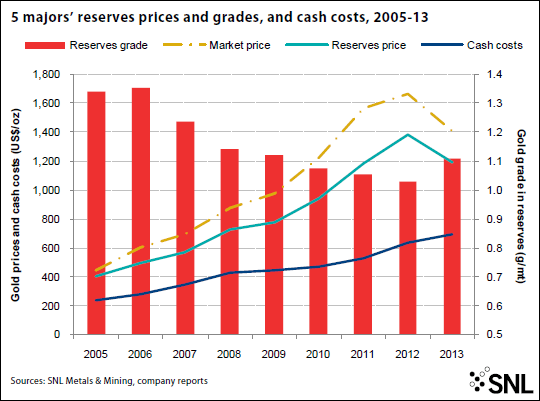
As predicted in February, a 15% year-on-year drop in the gold price in 2013 forced mining companies to lower the prices they use to calculate their gold reserves.
As the gold price climbed steadily from 2002 to 2012, gold producers increased their reserves calculation prices to allow profitable mining of lower-grade, higher-cost ores.
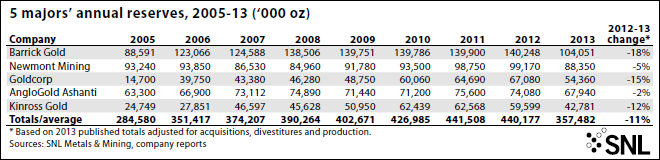
Examining the nine-year reserves history of five major producers— Barrick Gold Corp.Newmont Mining Corp.Goldcorp Inc.AngloGold Ashanti Ltd., and Kinross Gold Corp. — shows a 14% weighted-average decline in their reserves prices from 2012, an 11% average decline in their total reserves (net of changes due to acquisitions, divestitures, and production), and an 8% increase in their weighted-average reserves gold grade.
Majors' gold reserves shrink under pressure from lower gold prices
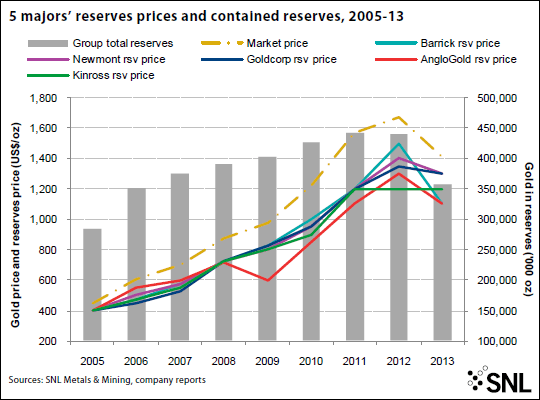
Barrick ended 2012 with 140.2 million ounces of gold in reserves at a reserves price of US$1,500/oz, the highest price among the five companies for the year.
It ended 2013 with 104.1 million ounces in reserves, using a reserves price 27% lower at US$1,100/oz; after adjustment for depletion and M&A activity, its reserves fell 18% in 2013.
The next-highest 2012 reserves price was US$1,400/oz used by Newmont; at US$1,300/oz in 2013, its adjusted reserves declined 5% from 2012.
Goldcorp's adjusted reserves declined 15% in 2013 at US$1,300/oz compared with US$1,350/oz in 2012.
AngloGold Ashanti's adjusted reserves declined only 2% in 2013 at US$1,100 compared with US$1,300/oz in 2012.
Kinross, having faced shareholder scrutiny since 2011 over its purchase of Red Back Mining, kept its reserves price at US$1,200/oz for the third consecutive year, but still reported a 12% drop in adjusted reserves in 2013 — with the adjustment including the 2013 write-down of 6.7 million ounces at its Fruta del Norte project in Ecuador after it failed to reach an agreement with the government on mine development.
The remaining decline in Kinross's reserves was largely due to an increased focus on mining higher-grade ore to reduce costs.
Majors' gold reserves shrink under pressure from lower gold prices

So far in 2014, gold prices have been volatile — spiking to $1,385/oz in March at the beginning of the Ukraine crisis after a three-year low of less than $1,200/oz at the end of 2013, and currently hovering around $1,300/oz.
Although analysts' 2014 gold price forecasts ranged between US$1,100/oz and US$1,400/oz, Newmont and Goldcorp used $1,300/oz at the end of 2013 — the most optimistic reserves price among the five majors.
We believe that the majors will likely continue to focus on cost-cutting in 2014 in order to preserve their profit margins, since significant further reserve cuts are unlikely in the near term as companies have already adjusted their strategies to accommodate market uncertainty and investor concerns.
Majors' gold reserves shrink under pressure from lower gold prices

Russia Holds "De-Dollarization Meeting": China, Iran Willing To Drop USD From Bilateral Trade

Russia Holds "De-Dollarization Meeting": China, Iran Willing To Drop USD From Bilateral Trade
That Russia has been pushing for trade arrangements that minimize the participation (and influence) of the US dollar ever since the onset of the Ukraine crisis (and before) is no secret: this has been covered extensively on these pages before (see Gazprom Prepares "Symbolic" Bond Issue In Chinese Yuan;Petrodollar Alert: Putin Prepares To Announce "Holy Grail" Gas Deal With ChinaRussia And China About To Sign "Holy Grail" Gas Deal40 Central Banks Are Betting This Will Be The Next Reserve Currency; From the Petrodollar to the Gas-o-yuan and so on).
But until now much of this was in the realm of hearsay and general wishful thinking. After all, surely it is "ridiculous" that a country can seriously contemplate to exist outside the ideological and religious confines of the Petrodollar... because if one can do it, all can do it, and next thing you know the US has hyperinflation, social collapse, civil war and all those other features prominently featured in other socialist banana republics like Venezuela which alas do not have a global reserve currency to kick around.
Or so the Keynesian economists, aka tenured priests of said Petrodollar religion, would demand that the world believe.
However, as much as it may trouble the statists to read, Russia is actively pushing on with plans to put the US dollar in the rearview mirror and replace it with a dollar-free system. Or, as it is called in Russia, a "de-dollarized" world.
Voice of Russia reports citing Russian press sources that the country's Ministry of Finance is ready to greenlight a plan to radically increase the role of the Russian ruble in export operations while reducing the share of dollar-denominated transactions. Governmental sources believe that the Russian banking sector is "ready to handle the increased number of ruble-denominated transactions".
According to the Prime news agency, on April 24th the government organized a special meeting dedicated to finding a solution for getting rid of the US dollar in Russian export operationsTop level experts from the energy sector, banks and governmental agencies were summoned and a number of measures were proposed as a response for American sanctions against Russia.
Well, if the west wanted Russia's response to ever escalating sanctions against the country, it is about to get it.
The "de-dollarization meeting” was chaired by First Deputy Prime Minister of the Russian Federation Igor Shuvalov, proving that Moscow is very serious in its intention to stop using the dollar. A subsequent meeting was chaired by Deputy Finance Minister Alexey Moiseev who later told the Rossia 24 channel that "the amount of ruble-denominated contracts will be increased”, adding that none of the polled experts and bank representatives found any problems with the government's plan to increase the share of ruble payments.
Further, if you thought that only Obama can reign supreme by executive order alone, you were wrong - the Russians can do it just as effectively. Enter the "currency switch executive order":
It is interesting that in his interview, Moiseev mentioned a legal mechanism that can be described as "currency switch executive order”, telling that the government has the legal power to force Russian companies to trade a percentage of certain goods in rubles. Referring to the case when this level may be set to 100%, the Russian official said that "it's an extreme option and it is hard for me to tell right now how the government will use these powers".
Well, as long as the options exists.
But more importantly, none of what Russia is contemplating would have any practical chance of implementation if it weren't for other nations who would engage in USD-free bilateral trade relations. Such countries, however, do exist and it should come as a surprise to nobody that the two which have already stepped up are none other than China and Iran.
Of course, the success of Moscow's campaign to switch its trading to rubles or other regional currencies will depend on the willingness of its trading partners to get rid of the dollar. Sources cited by Politonline.ru mentioned two countries who would be willing to support Russia: Iran and China. Given that Vladimir Putin will visit Beijing on May 20, it can be speculated that the gas and oil contracts that are going to be signed between Russia and China will be denominated in rubles and yuan, not dollars.
In other words, in one week's time look for not only the announcement of the Russia-China "holy grail" gas agreement described previously here, but its financial terms, which now appears virtually certain will be settled exclusively in RUB and CNY. Not USD.
And as we have explained repeatedly in the past, the further the west antagonizes Russia, and the more economic sanctions it lobs at it, the more Russia will be forced away from a USD-denominated trading system and into one which faces China and India. Which is why next week's announcement, as groundbreaking as it most certainly will be, is just the beginning.

New Cheaper, Greener Perovskite Solar Cells To Replace Lead with Tin

New Cheaper, Greener Perovskite Solar Cells To Replace Lead with Tin
Researchers have developed a new cheaper, greener Perovskite Solar cells with no lead. They put tin instead of lead Perovskite as the light harvester. The result was a new solar cell with good efficiency than the other. It could be made easily by “bench” chemistry techniques. The manufacturing process involves the use of completely viable materials and completely eliminates hazardous materials.
Inorganic chemist, Mercouri G. Kanatzidis who has a great skill in dealing with tin, said that this was an advanced step in replacing lead with tin in the very promising type solar cell known as Perovskite. He said that the metal tin is more viable than lead and it worked good to make an efficient solar cell.
As it was in a structure called Perovskite, it is called so. Instead of lead the new one has tin as the light absorbing material. Tin Perovskite has efficiency same as that of lead Perovskite or even more. Thus it can be touted as the “next big thing in photovoltaic”. The materials was developed, synthesized and analyzed by Kanatzidis. Along with the help of Robert P H Chang, Northwestern collaborator and nano scientist, he engineered the new efficient solar cell.
The two main features of the material is it can absorb most of the visible light spectrum and second one the Perovskite salt can be dissolved and it will reform upon solvent removal without heating.

Nickel Ore inventories at China's ports enough for five-month consumption

Nickel Ore inventories at China's ports enough for five-month consumption
Shanghai Metals Market expects nickel ore inventories at China’s ports to be sufficient for five-month consumption at least.

As of May 9, nickel ore inventories at major five Chinese ports totaled 13.43 million tonnes, down 5.50 million tonnes or 29% from the level before the ban took effect January 12, according to a survey by SMM.

The SMM survey shows Chinese NPI producers need 4 million tonnes of nickel ore for production every month, and monthly imports from the Philippines are around 1.5 million tons, leaving monthly consumption of port inventories around 2.5 million tons.

It is worth noting that production halts have occasionally happened in Ulanqab, Inner Mongolia due to environment protection inspections, and this will slow the decline in port inventories.

Prices for high-grade ore, domestic nickel, high-grade NPI and LME nickel have surged by 100%, 56%, 47% and 45%, respectively, from when Indonesia introduced its ban on unprocessed ore exports , according to SMM’s pricing data.

Such strong gains were due mainly to strong market speculation after the Indonesian ban, SMM believes.

The maximum amount of medium and high-grade nickel ore (Ni 1.5% and above) that the Philippines is capable of exporting each year is approximately 20 million tons. In 2013, China consumed over 40 million tons of medium and high-grade nickel ore, far above the current export capacity in the Philippines.