Monday, May 26, 2014

Growing Use of Aluminium in Auto Industry Concerns

Alexey Mordashov, OAO Severstal billionaire CEO said the increasing use of aluminium in cars is a worrying factor for the steel producers. The industries were now grappling with excess capacity. Mordashov, in Bloomberg Television interview at the St. Petersburg International Economic Forum on Thursday, said the usage of steel substitutes in auto industry had been evident for decades.
He said that the steel producers has already made responses for the challenges due to steel substitute materials and must continue so. Automobile industry has started using aluminium in cars as it reduce the weight and also curtail the carbon emissions to the atmosphere. It meets all environmental standards.
Automobile industry Ford Motor Co. (F) will launch its new aluminium bodied F-150 pickup this year. This would add more aluminium, i.e., more than 250,000 tons, regarding the U.S demand for aluminium, based on Bloomberg Industries Report. Mordashov said that his industry continued to tackle the excess capacity.
Severstal billionaire CEO said, “We see global steel demand increasing by 3.5 percent to 4 percent this year; however, the shutting of capacities is going slower”. He said the countries admitted to cut down the global production so as to save the industries itself, last year. But, there was nothing happening in that regard, he added.
Severstal is planning to consider options for its U.S assets. These include a blast furnace in Michigan, which was built by Henry Ford, which delivers steel for the companies from Ford to Chrysler Group LLC. Severstal CEO said they would consider either of two choices- to develop or to dispose for their Dearborn and Columbus, Mississippi plants.
Mordashov said the diminishing trust had been the worst result so far of U.S and European Union Sanctions against the Russian Government. The company has not experienced any pressure due to the Ukraine crisis, he said, as it is not a factor in the possible sale of American business. 
Growing Use of Aluminium in Auto Industry Concerns
Image Source : DUPRESS.COM

Sunday, May 25, 2014

World Aluminium Conference, Duty-paid aluminium premium breached $400 per tonne for the first time in its history this week.

World Aluminium Conference, Duty-paid aluminium premium breached $400 per tonne for the first time in its history this week.
Bauxite export restrictions might put upward pressure on aluminium pricing.

Scrap traders are familiar with resource nationalism when it takes the form of export bans and restrictions on scrap metal leaving a given country. Those in attendance at the 2014 CRU World Aluminium event may have been sympathetic to similar restrictions facing the mineral ores sector. 
Sola Adebiyi, a senior consultant with London-based CRU, provided an update on bauxite ore export restrictions affecting the global aluminum market. The bans may ultimately exert upward pressure on the price of aluminum, according to Adebiyi and her colleagues at CRU.
 
The bauxite ban with the greatest current and potential affect is Indonesia’s near-total export ban, which went into effect in January 2014. The aim of the ban, said Adebiyi, is to attract major new capital investments in smelting and refining to Indonesia and to create jobs in the country.
 
According to Adebiyi, in recent years from 70 percent to 80 percent of China’s imported bauxite has been shipped from Indonesia. The 80 percent figure in 2013 occurred in part because Chinese aluminum smelters imported stockpiles of Indonesian bauxite in late 2013 to prepare for the export ban. Adebiyi said those stockpiles are likely to reach their end in the third quarter of 2014 if Indonesia does not lift or alter the terms of its export ban.
 
Among the alternative sources of bauxite for Chinese smelters is India, but that nation has enacted a 10 percent tariff on bauxite. Chinese companies are likely to turn toward Australia, Guinea and even as far away as Jamaica for bauxite, although importing from each of those nations involves higher shipping costs.
 
Adebiyi’s CRU colleague Michael Insulán said buyers in China’s Shandong Province have already been paying $80 per metric ton for bauxite ore delivered from distant ports, some $20 to $30 per ton higher than buyers with more favorable shipping routes.
 
In another World Aluminium event session, CRU’s Colin Pratt said the bauxite export bans “probably won’t do the economies of these countries any good, but it could do the aluminium industry some good.” The bans and tariffs could help to balance the primary industry’s overcapacity situation and exert some upward pressure on the price of aluminium, which would be welcome news for scrap dealers as well.
 
The 2014 CRU World Aluminium event was at the JW Marriott in Hong Kong May 19-20.

 Duty-paid aluminium premium breached $400 per tonne for the first time in its history this week. 
May 23 Europe: 1,500 tonnes of duty-paid aluminium sold at $415 per tonne Europe: 3,000 tonnes of duty-unpaid aluminium sold at $340-345 per tonne May 22 Europe: Small lots of duty-paid aluminium sold at $415-420 per tonne Europe: Duty-unpaid aluminium busienss reported at $340 per tonne May 21 Japan: Spot MJP cif indicated at $380-390 per tonne Europe: 3,000 tonnes of duty-unpaid aluminium sold at $340 per tonne Europe: 500 tonnes of duty-paid aluminium sold at $415 per tonne

Global Trade Tumbles Most In 5 Years.

Do not look at this chart if you remain of the opinion that everything is fine in the world. For the 3rd time in the last 4 months, world trade volumes dropped. The 0.5% fall in March - it must have been weathery all over the world? - continues the biggest plunge in global trade since May 2009. As WSJ reports, exports from developing economies in Asia recorded the largest decline, a drop of 4.5%. Central and Eastern Europe was the only region to record a rise in exports as the decline in trade flows is consistent with other evidence that suggests the global economy got off to a weak start this year. So, $12 trillion of global money printing and world trade is unable to sustain growth...

The last 4 month shave seen the biggest tumble in world trade since the financial crisis...
Global Trade Tumbles Most In 5 Years


As World Trade has decoupled from the money-printing mania of the central banks as transmission mechanisms everywhere are saturated and broken...
Global Trade Tumbles Most In 5 Years

Must mean that the central planners just need to print more?

Charts: Bloomberg

How U.S.A Spend Their Time Online

We have good news for budding entrepreneurs considering launching yet another online method of stalking the object of their affection: exhibitionism and sharing photos of your dinner, pardon social networking, remains as popular as ever on the internet.
According to an online survey by GfK and the Interactive Advertising Bureau, people said they spent about an average of 37 minutes a day on social networks like Facebook and Twitter in 2013. That internet staple, emailing, clocked in at a 29 minutes, while watching online video was 23 minutes.
How U.S.A Spend Their Time Online - social networks, games, online video
However, in a troubling trend for the YouTubes of the world, the WSJ notes that while people doubled the amount of time they spent watching online video over the past four years, the overall percentage of their online time spent watching video slipped to 12% in 2013 from 13% the year before.
But the worst news is for that biggest loser of all in the New Online Normal: legacy media, whose paper publications are an endangered anachronism in a day and age when everyone reads (if only the headlines) on their mobile device, is also getting hammered when it comes to its online incarnation, with the average American spending just 5 minutes reading online newspapers, less than even blogs.
Of course, when the day comes that the final investigative reporter and journalist loses their job, suddenly the question will arise what will all those 20-some year old "journalism" majors whose only skill is to copy and paste, do?
For now nobody cares to even contemplate this issue: they are too busy updating their Facebook profiles.

Friday, May 23, 2014

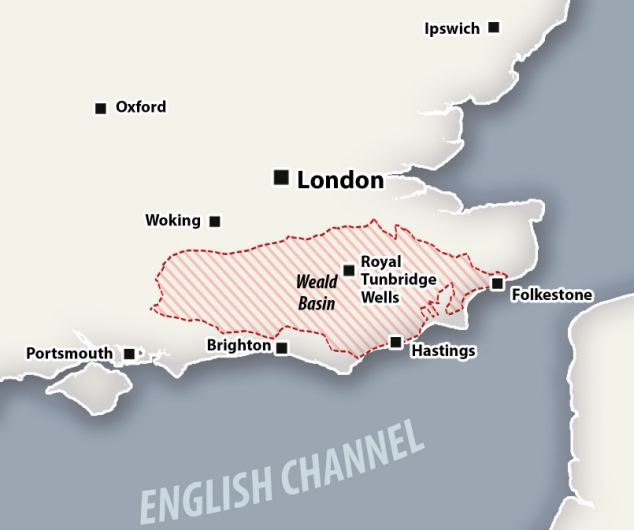
Billions of barrels-worth of shale oil found in southern England

About 4.4 billion barrels-worth of shale oil have been found in the ground beneath the south of England, according to a report published Friday by the British Geological Survey (BGS).
The study, commissioned by the Department for Energy and Climate Change and released this morning, says the huge oil reserves lie under the Weald Basin in Kent and parts of Sussex and Surrey.
How much of this is recoverable is not yet known — further drilling and testing of new wells will be needed to establish this, but the discovery is set to spark a new stage in the battle between environmentalists and energy firms over the controversial topic of fracking.
The discovery has already pushed British authorities to start mulling plans to ease rules on accessing shale oil and gas, including drilling without landowners' permission
The discovery has already pushed British authorities to start mulling plans to ease rules on accessing shale oil and gas, including drilling without landowners' permissionreports Reuters.
Under the new plans, energy firms will be allowed to dig 300 metres (1,000ft) down for shale gas and deep geothermal operations provided they notify local communities and give them a “voluntary community payment” for access to the land of US$34,000 per well.


Last year, the BGS published a study of the Bowland Shale in northern England, which, it said, contained about 1,300tn cubic feet of gas. Analyst say that even if only a tenth of that were extracted, it would be the equivalent of 40 years’ gas supply for the UK.

Aluminum Reaches Three-Week High on Shortage Speculation

Aluminum Reaches Three-Week High on Shortage Speculation
Aluminum reached a three-week high in London on speculation supply of the lightweight metal will run short of demand. Copper headed for a third weekly climb as available supplies shrank further.
The aluminum market will be in deficit this year by 1.3 million metric tons, leading global producer United Co. Rusal said today. China’s imports of bauxite, used to make the metal, dropped 14 percent in April, customs data showed this week. There were no shipments from Indonesia, China’s main supplier in 2013, which banned raw-ore exports in January of this year.
“Concerns of the Indonesian ore ban impacting bauxite availability have been voiced recently,” Vicky Sanders, head of analytics sales at Marex Spectron Group, said in a note. “We would caution that tightness isn’t expected to have a material effect until mid-2015/2016.”
Aluminum for delivery in three months added 1.3 percent to $1,819 a ton by 12:43 p.m. on the London Metal Exchange after touching $1,824, the highest since April 29.
Copper was set for the longest weekly winning streak since February after inventories available for removal from LME warehouses fell below 100,000 tons for the first time since 2008. Stockpiles total 175,850 tons, of which 92,650 tons is available for delivery, according to daily data. The remainder is earmarked for removal.
The metal for delivery in three months gained 0.6 percent to $6,915 a ton on the LME, leaving prices up 0.8 percent this week. Copper for immediate delivery traded at an $80-a-ton premium to the three-month contract, indicating limited supply. The metal for delivery in July on the Comex inNew York rose 0.7 percent to $3.164 a pound.
“Copper remains supported above $6,850 by lower stockpiles and higher premiums for immediate deliveries,” RBC Capital Markets LLC said in a note.
Disrupted output at LS-Nikko Copper Inc. also aided copper, said Chae Un Soo, a metals trader at Korea Exchange Bank Futures Co. in Seoul. The company was ordered to halt operations at a smelter after a fire broke out yesterday. Operations at another smelter remain suspended after a blast on May 13.
Tin, lead and zinc climbed in London. Nickel fell.

Rusal hikes Aluminum offer prices to Japan to $405/Mt for Q3

Rusal hikes Aluminum offer prices to Japan to $405/Mt for Q3
The world's biggest aluminum producer United Company RUSAL has raised its aluminum offer prices to Japan, as per the latest reports.

A news from Platts mentioned, the Russian aluminum giant 
has offered to Japanese buyers, a premium of $405 a metric ton to London Metal Exchange cash, CIF Japan, for third quarter shipments.

The prices are for primary aluminum ingot, sows and T-bars of LME P1020A specification, imported into Japan in the third quarter.