Friday, June 27, 2014

After 125 years, Alcoa looks beyond aluminum

After 125 years, Alcoa looks beyond aluminumAlcoa Inc, the company that helped create the aluminum industry more than a century ago, is reinventing itself as a manufacturer of specialized components for aerospace and automotive customers, including some that contain no aluminum at all.
The company's deal for jet engine part maker Firth Rixson, which uses little aluminum, is its biggest move yet to escape the terrible primary aluminum market by crafting the parts its customers need, even if they are made of nickel or titanium.
It announced the proposed $2.85 billion deal to buy Firth Rixson earlier on Thursday.
Alcoa talks constantly about expanding its downstream businesses, which sell truck wheels, aircraft parts and other goods. Now it is rebranding itself in ways that would have seemed unthinkable just a few years ago.
"We are really material-agnostic," Chief Executive Officer Klaus Kleinfeld said in an interview on Thursday. "We love, internally, that we have fights over what is the right material, in front of our customers, together with our customers."
From an upstart, this would be one thing. But Alcoa has been synonymous with aluminum since 1888, and it has a role in every part of the sector: mining bauxite, refining it into alumina and smelting alumina to create aluminum.
And yet in retrospect, Thursday's deal is not the first sign of a shift into other metals. Aerospace, which accounted for 17 percent of revenue last year, is already dominated by nickel-based alloys and titanium, as well as aluminum-lithium alloys.
In January, Alcoa quietly revised the company description that appears in its news releases. Instead of "the world's leading producer of primary and fabricated aluminum," it now introduces itself as "a global leader in lightweight metals engineering and manufacturing."
Last week it said it would invest $25 million in Hampton, Virginia, to produce largely nickel-based alloy jet engine blades. In May, it broke ground on a $100 million facility in Indiana to make nickel-based alloy engine parts.
Investors are not complaining. Alcoa's stock has been climbing more or less steadily since late last year, and is up more than 80 percent from a year ago.
"I think it's a good thing," said Tim Ghriskey, chief investment officer of Solaris Group, referring to the Firth Rixson deal. "It makes aerospace a bigger part of Alcoa, and to us it's a business with a wide moat."
Ghriskey also said the deal would diversify Alcoa, and that was likely boosting the stock. Shares closed up 2.7 percent at $14.94 on Thursday.
DIVERSIFY, DIVERSIFY, DIVERSIFY
Aerospace has long been a key market for aluminum producers, but Alcoa and its rivals are also expanding in the U.S. automotive industry, once virtually owned by the steelmakers.
That battle came up often at last week's Steel Success conference in New York. At one point an audience member asked Lakshmi Mittal, chief executive of top steelmaker ArcelorMittal SA, why he would not just buy an aluminum producer. The audience laughed.
"You can also tell aluminum companies that steel is a better solution. They should buy steel companies," Mittal said, to applause. The next questioner changed the subject.
But in the face of low prices and excess capacity, steelmakers should also consider diversifying into other materials, said John Lichtenstein, Accenture's global managing director for metals.
"There's sort of the mindset of, zero sum, winner take all, in the automotive war in particular," he said. But automakers have told him they want suppliers to look at the entire vehicle, to help work out the best mix of materials and solve technical problems like how best to join them together.
SPIN OFF?
The Firth Rixson deal is sure to revive the debate over whether Alcoa should remain vertically integrated, or break itself up as rival Alcan did in 2005, when it spun out Novelis, which makes aluminum sheet for beverage cans and cars.
Asked about a spin-off, CEO Kleinfeld said Alcoa is well-positioned right now, and pointed to the higher-cost smelters it has shut down in the last few years, as well as its joint venture in Saudi Arabia, which is expected to boast low operating costs once it has ramped up.
"We've come down substantially on the cost curve. We will continue to come down," he said. But he added the company is always looking at its portfolio.

In general, Lichtenstein said, vertical integration can benefit aluminum companies that have access to high quality bauxite, which is in tighter supply, than, for example, iron ore, used to make steel. 

Zinc Breaks Through: Demand, Scarcity Create Bull Market

Zinc has surged 12% in the past 2 months. The metal might reach a 3-year high soon, and that could finally allow Zinc prices to increase to new levels. As we commented 2 weeks ago, the metal was showing a bullish technical pattern and we would expect it to keep going up.
3M LME Zinc price since 2013
The fundamental picture supports a bullish attitude. Demand is expected to keep growing for the coming years, while the looming closure of major mines such as Century in Australia and Lisheen in Ireland next year due to mineral depletion, has most analysts predicting the deficit of this year only getting worse in the years to come. In the meantime, mining companies have been slow to open new zinc mines and LME stocks fell last week to a three-year low.
Commodities and, in particular, base metals have been in a falling market since the spring of 2011 and that’s also a reason why zinc hasn’t been able to turn its price around ever since. However, commodities made a key upward move this year and some industrial metals have already started to show some life. A further recovery in commodities and the metals sector will definitely help zinc on its way up.
3M LME Zinc Price on the LME
3M LME Zinc Price since 2011
We have seen many times that prices can move in the opposite direction of what the fundamental picture is saying. This is because many of these fundamentals are already discounted in the price and that is why, despite of having a fundamental opinion of the future, you should always wait for price actions before making purchasing decisions.
What This Means For Metal Buyers
Zinc is at its highest level since February 2013 and chances are that it breaks to a new three-year high. The fundamental and technical pictures are pointing to higher prices. If zinc manages to push onto new ground, we recommend buyers take their risk off the table and start taking long-term positions as prices will likely trend upward.

Zinc Approaches 16-Month High in London as Supples Fall

Zinc Approaches 16-Month High in London as Supples Fall
Zinc rose, trading near a 16-month high, as inventories in warehouses tracked by the London Metal Exchange declined amid signs of improving demand.
Stockpiles fell for a fourth session, extending a slide to the lowest since December 2010. Zinc, used in everything from brass plumbing fixtures to steel car parts, has gained 10 percent this quarter amid signs of recoveries in manufacturing and housing. U.S. new-home sales posted the biggest one-month gain since 1992 in May, while American factories received more orders for business equipment, government data showed this week.
“There’s some demand influences and some supply influences” pushing zinc prices higher, Michael Turek, a senior director at Newedge USA LLC in New York, said in a telephone interview. “There’s genuine demand for it. The industrial performance in the U.S. is quite robust.”
Zinc for delivery in three months climbed 0.4 percent to settle at $2,190.50 a metric ton by 5:50 p.m. on the LME, after reaching $2,195.50. On June 23, prices climbed to $2,198, the highest since Feb. 15, 2013.
Copper for delivery in three months rose 0.6 percent to $6,955 a ton ($3.15 a pound) on the LME. On the Comex in New York, copper futures for delivery in September gained 0.2 percent to $3.172 a pound. Prices advanced for a 10th session, the longest rally since June 2005.
Inventories monitored by the LME have fallen 57 percent this year to the lowest since August 2008.
Nickel and lead climbed in London. Aluminum and tin fell.

Thursday, June 26, 2014

CHARTS: Gold price entering make or break territory

The gold price jumped around on Wednesday only to settle in familiar territory.
On the Comex division of the New York Mercantile Exchange, gold futures for August delivery in late afternoon trade exchanged hands for $1,319.50 an ounce, down $1.80 from its settlement level in middling volumes.
Earlier in the day gold touched a low of $1,305.40, only recovering after a drop in the dollar following a surprisingly large down adjustment in the first quarter US GDP.
Last Thursday's nearly $50 an ounce surge in frenzied trading now appears to have been a blip as gold's momentum turns sideways.
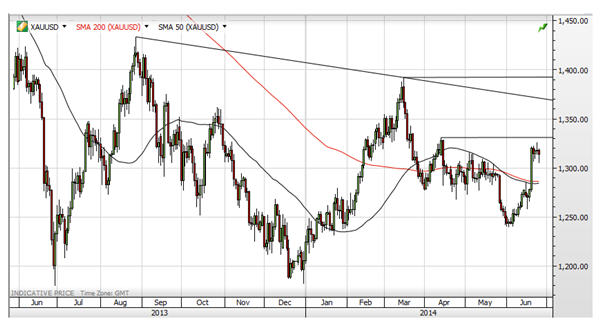
Ole Hansen, Head of Commodity Strategy at Denmark's Saxo Bank, says for gold to continue to show strength the metal must first clear $1,331:
If successful it should be able to make further progress towards trend-line resistance at 1371 USD/oz ahead of the 2014 peak at 1392 USD/oz. However, a move back below 1300 USD/oz would remove the current momentum and most likely result in a renewed period of range-bound trading around 1295 USD/oz. which has been the average price for the past year.
CHARTS: Gold price is entering make or break territory
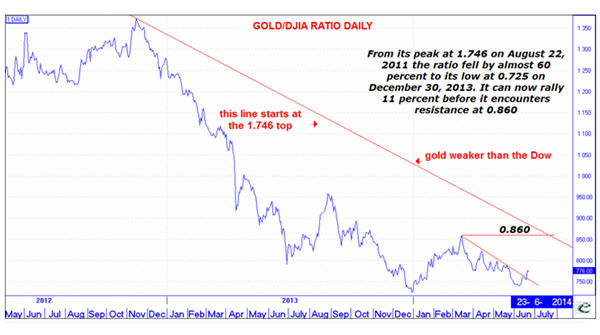
Technical research and investment blog InvesTRAC's chart of the gold price versus the blue-chip Dow Jones Index, which on Wednesday was again toying with record territory despite the GDP numbers, indicates that gold is set to outperform stocks:
The long term downtrend from the top at 1.746 is still intact…the recent weakness held above the 0.725 low and the ratio has now pushed up through the first downtrend which opens the way for an 11 percent rally to the next visible resistance at 0.860. If the ratio can get through this barrier it would suggest that after an almost 60 percent decline it would have the potential to go substantially higher:
CHARTS: Gold price is entering make or break territory
FLASHBACK:
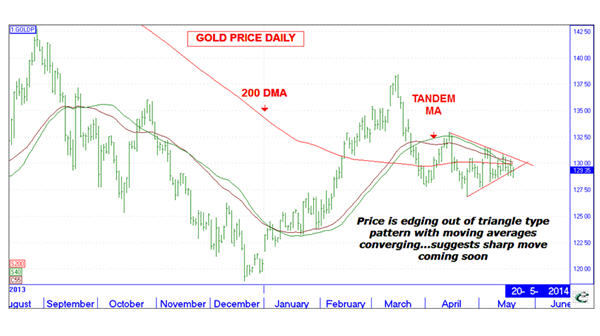
Towards the end of May, InvesTRAC produced a chart showing that the uncharacteristically quiet gold market was primed for break-out price move. That bust out if its trading range started out as a big gap down with the gold price hitting $1,244 at the start of June. That was before Yellen and ISIS changed the picture again and a 90 tonne 15-minute trade lit a fire under the metal.
CHARTS: Gold price is entering make or break territory

Visualizing The Five Reasons To Own Gold

Following last night's 94-page extravaganza on goldthis infographic, part four in our 2014 Gold Series (part 1, part 2, & part 3 here), covers the five best reasons to own gold: 1) Gold helps investors diversify their portfolios; 2) Gold is a great store of value; 3) Gold helps protect against inflation and other risks; 4) Gold demand is driven by a growing east, while grades are dropping and new discoveries are more scarce; and 5) Gold stocks are as cheap as they have ever been, using the GDX as a proxy. The reasons to own gold have not changed since the peak in 2011.

Citi Warns US Equities Are Facing A Pullback

US equity indices are showing signs that a pullback may be developing, Citi's FX Technicals group notes, as the S&P 500 Index, the NASDAQ Composite Index and the Dow Industrials Index all posted bearish key days yesterday. A short-term correction on the order of 3%-6% may be developing on the back of this.
The Dow Transports Index, which has been the leading US equity Index this year, has already been showing signs of stress as well. The VIX Index is also turning higher from low levels and should head up towards at least 14% if not 18% if the pullback in equities materializes.

Citi Warns US Equities Are Facing A Pullback

The US S&P 500 Index posted a bearish key day at the trend highs yesterday. (The last bearish key day at trend highs back in April was followed by a high to low move of -4.4%.) Daily momentum also turned lower and negative momentum divergence has developed (though not triple divergence).
A short-term pullback towards supports around 1920-1925, the converging channel bottom and recent low, appears likely at this point. A break below there then opens the way to good supports around 1900, which would result in a high to low correction of around 4%.
At this point our bias is that a short-term pullback to the above supports would not be out of line within the overall trend higher (markets don’t move in straight lines after all). However, a deeper correction, which is not yet our base case, could see a pullback towards the 1814-1820 area (converging April low and 200 day moving average, which has not been tested since 2012).
Other equity markets are also showing signs of stress.

Ceiling, floor prices

Ceiling, floor prices
In equities or commodities markets, prices tend to rise or fall abnormally sometimes. In such circumstances, it is necessary to protect an investor from such sharp movements. It is here that ceiling or floor comes into play. Ceiling is applied when prices rise and floor comes into play when rates fall.

An important other objective of the concept of ceiling and floor is to prevent excess volatility in a commodity. This leads to sharp price swings and lower volume, ultimately affecting liquidity in trade.

In India, the Forward Markets Commission, which supervises the functioning of commodity exchanges, has termed the ceiling as daily price limits. It has fixed different limits for agricultural and non-agricultural commodities.

According to the norms fixed by the Forward Markets Commission, the limit for prices of agricultural commodities to either rise or fall is four per cent. Among non-agricultural commodities, the limit is four per cent for PVC and six per cent for steel. For other commodities such as energy products and metal, which are traded on the global platform too, the ceiling/floor is nine per cent.
Even for the price limit, the commission has set a cooling period. For some commodities, this comes into effect the moment prices rise or fall by two per cent. In some commodities, considered as commercial crops, the limit is three per cent. The cooling period is for 15 minutes. After this, the prices cannot rise or drop beyond the set daily limit.

For non-agricultural commodities, the cooling period come into play once prices gain or lose by four per cent (it is three per cent for gold). After that there are two more slabs of two and three per cent (three per cent each for gold) limit to hit the limit.

According to the Ministry of Consumer Affairs, which keeps a tab on commodity exchanges, the daily price limit has been reached 4,746 times for various commodities between 2011 and April 2014.